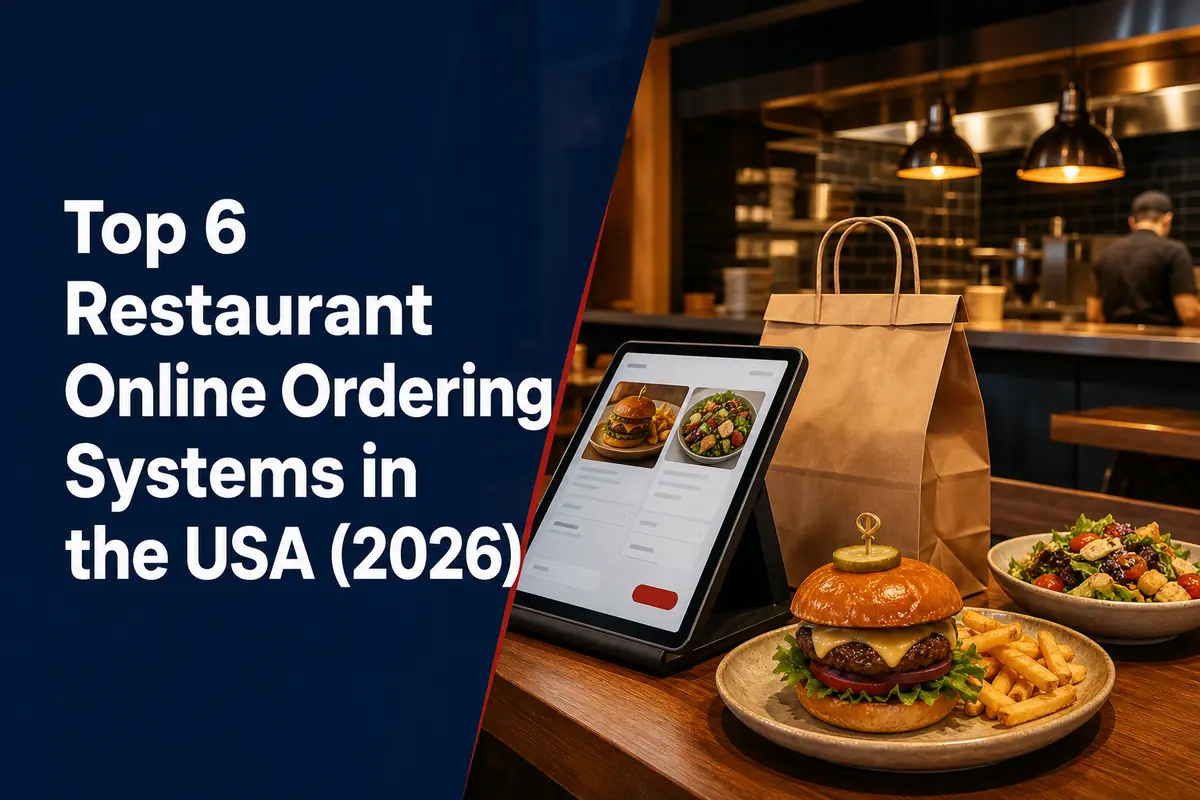
Online ordering can create a valuable direct sales channel, but the cheapest-looking platform is not always the lowest-cost choice. Subscription charges are only one part of the bill. Payment processing, per-order fees, delivery dispatch, menu integrations, website work and promotional tools can change the economics considerably.
This guide compares six restaurant online ordering systems available in the United States: ChowNow, Olo, Owner.com, Popmenu, Square and Toast. They serve different operators—from an independent takeout restaurant testing direct orders to a multi-brand chain needing enterprise integrations.
Editorial note: ChefPin did not accept payment for inclusion or position in this guide. The list is organized by best-fit use case, not by a universal score. Product details and public prices were checked against vendor materials in August 2026; request a written quote before buying because packages and fees can change.
Quick comparison
| System | Best fit | Public software price | Ordering fee or commission | Important consideration |
|---|---|---|---|---|
| Square | Small restaurants already using Square | Free plan available; paid restaurant plans available | No marketplace commission on direct profile orders; processing and delivery-provider fees can apply | Best value usually comes from staying inside the Square ecosystem |
| Toast | Restaurants using or moving to Toast POS | Quote required for the relevant suite | Confirm processing, delivery and add-on charges in the proposal | Strong operational integration, but it is not a POS-neutral choice |
| ChowNow | Independents prioritizing direct ordering and marketing | From $229/month annually or $249 monthly | Processing and selected-channel fees apply | Compare the whole plan and optional services, not just “commission-free” wording |
| Owner.com | Independent restaurants wanting an all-in-one growth platform | $249/month + 5% restaurant fee per order, or $499/month flat rate | Depends on selected plan; payment and delivery costs may also apply | The break-even point depends heavily on direct online sales volume |
| Popmenu | Restaurants combining website, marketing and direct orders | Quote-based; public calculator references some package pricing | Popmenu says direct ordering has no per-order commission; card processing applies | Ask which website, marketing, loyalty and app features are included |
| Olo | Large multi-location and enterprise restaurant brands | Quote required | Contract-specific | Extensive scale and integrations may be unnecessary for a single location |
This table is a screening tool, not a substitute for a proposal. “Commission-free” normally means the software provider does not take a marketplace-style percentage from a direct order. It does not necessarily mean the transaction is free.
How we evaluated the platforms
We focused on the questions that affect restaurant profit and daily execution:
- Can the restaurant own the ordering relationship and access usable guest data?
- Does the menu synchronize with the POS, or will staff maintain it twice?
- Do orders enter the kitchen automatically instead of landing on another tablet?
- What do subscription, payment, delivery, setup and add-on charges cost together?
- Can operators control order throttling, lead times, sold-out items and service areas?
- Does the platform support pickup, first-party delivery or on-demand courier dispatch?
- Can the system serve multiple locations without creating menu and reporting chaos?
- Are loyalty, marketing, catering, apps and websites included or sold separately?
- Is support available during the restaurant's actual trading hours?
We used public vendor pages for product and price details. Features evolve, so every restaurant should test its own menu and obtain contract terms in writing.
1. Square: best for a straightforward, low-entry-cost launch
Square Online Ordering is a natural first choice for restaurants already running Square. Its ordering profile uses the restaurant's menu and can support pickup and delivery. Orders, menu data and customer information remain within the same ecosystem, reducing the likelihood of staff re-keying tickets.
Square says restaurants can launch a branded ordering profile without an extra monthly fee on its free option. Its current U.S. structure also includes paid Square Plus and Premium plans. Direct profile orders do not carry a marketplace commission, but online payment processing still applies. On-demand delivery also creates a delivery-service-provider fee that may be charged to the restaurant or passed to the customer, depending on configuration.
Where Square stands out
- Low barrier to testing direct pickup orders
- Native synchronization with Square POS and kitchen workflows
- Menu hours, taxes, service charges, discounts and fulfillment controls
- Multi-location ordering from one profile
- Familiar dashboard for existing Square operators
What to verify
Check the exact online processing rate for your plan, custom-domain and website needs, delivery dispatch charges, loyalty costs and any advanced restaurant features you require. A free software tier can still have meaningful variable costs at higher sales volumes.
Best fit: a food truck, café, counter-service business or small restaurant that already uses Square and wants a simple direct channel.
2. Toast: best for restaurants prioritizing POS-to-kitchen integration
Toast Online Ordering sits inside Toast's restaurant technology ecosystem. The product supports branded pickup, curbside and delivery ordering pages, while orders flow to the Toast operation rather than a separate marketplace tablet.
Toast's support documentation places Online Ordering within its Digital Storefront Suite and directs operators to request pricing. That means a useful comparison requires a written proposal showing the relevant POS plan, digital storefront package, payment processing, delivery, hardware and implementation costs.
Where Toast stands out
- Restaurant-specific POS, menu and kitchen integration
- Unified operational workflow for online and in-house tickets
- Pickup, curbside and delivery configurations
- Natural fit for restaurants already committed to Toast hardware and payments
- Access to a wider restaurant software ecosystem
What to verify
Ask whether the quoted package includes the website experience you expect, branded app options, loyalty and marketing, catering, order-and-pay features, delivery dispatch and support. Also test modifiers, scheduled menus, throttling and refunds in a live-style demonstration.
Best fit: a full-service or quick-service restaurant that values one connected operating system and already uses—or has selected—Toast POS.
If the POS decision is still open, compare the broader stack in ChefPin's guide to restaurant POS systems in the USA before evaluating ordering as a standalone add-on.
3. ChowNow: best for independent restaurants focused on direct growth
ChowNow positions its platform around direct, commission-free ordering for independent restaurants. Its 2026 public pricing lists Launch from $229 per month on an annual plan or $249 month-to-month, Grow from $319 annually or $349 monthly, and Elevate from $409 annually or $449 monthly.
The packages combine more than a checkout page. Depending on the plan, the platform describes an ordering suite, website, branded mobile app, discovery connections, catering, marketing, loyalty, delivery management, integrations and support.
However, “commission-free” should not be read as “fee-free.” ChowNow's published partner pricing sheet lists payment processing, possible setup and hardware expenses, plus fees for selected services such as catering, discovery-network orders and Flex Delivery. Operators should confirm the current amounts and which charges apply to their configuration.
Where ChowNow stands out
- Direct-ordering focus for independent restaurants
- Public starting subscription prices
- Ordering, marketing and customer-retention tools in one offering
- POS integrations and delivery-management options
- Monthly and annual plan choices
What to verify
Request an itemized model at your monthly order count. Separate website subscription, payment processing, delivery, discovery, catering, printer, app and setup charges. Confirm whether guest data can be exported in a practical format and what happens to the website, app and data if the contract ends.
Best fit: an independent restaurant prepared to market its own channel and willing to pay a predictable platform subscription for broader growth tools.
4. Owner.com: best for an all-in-one direct-sales and marketing approach
Owner.com combines a restaurant website, online ordering, branded mobile app, loyalty, automated marketing and SEO-oriented pages. Its public pricing currently offers two models:
- Flexible: $249 per month plus a 5% restaurant fee per order
- Flat Rate: $499 per month with no additional restaurant fee
Owner.com says its plans are month-to-month and that special multi-location rates are available. The two-plan structure creates a clear volume decision. Ignoring other costs, the extra $250 monthly subscription for Flat Rate equals the 5% platform fee at $5,000 in direct online sales per month. This simple break-even matches the vendor's stated positioning, but restaurants must still add payment processing, delivery and any applicable service costs.
Where Owner.com stands out
- Website, ordering, app, loyalty and marketing under one subscription
- Public pricing and a simple volume-based plan choice
- Month-to-month positioning rather than a long initial commitment
- Designed specifically around a restaurant's direct digital channel
What to verify
Confirm payment processing, courier delivery, onboarding, app-store, SMS or premium-feature costs. Ask who controls the domain, website content, customer list and analytics. Review how menu changes reach the POS and kitchen, especially during busy periods.
Best fit: an independent restaurant that wants a managed direct-growth package and expects enough order volume to justify the monthly cost.
5. Popmenu: best for combining interactive menus, marketing and ordering
Popmenu Online Ordering connects direct ordering with an interactive menu, website, guest contacts, loyalty, marketing and performance insights. Popmenu states that direct orders carry no per-order commission to Popmenu, while card processing still applies. Pickup and curbside are supported, and delivery can use the DoorDash driver network for a flat fee.
Popmenu's public materials emphasize integrations with major POS providers, direct routing to the kitchen and tools for limited-time ordering events. That combination may suit restaurants that see their menu, website content and marketing database as one customer-acquisition system rather than separate tools.
Pricing is largely sales-led. A public Popmenu calculator references package pricing, but a restaurant should rely on its dated, itemized proposal—not a calculator assumption—to compare costs and inclusions.
Where Popmenu stands out
- Visual, interactive menu and website experience
- Direct ordering linked with guest marketing and loyalty
- Ordering events for holidays, catering or limited menus
- POS integrations and order routing
- Branded app and delivery options
What to verify
Ask for the monthly package price, payment rate, delivery fee, implementation charge, contract length and renewal terms. Confirm which marketing messages or contacts are included, whether app functionality costs extra, and how menus and modifiers synchronize with your particular POS.
Best fit: a restaurant that wants to improve its website, menu merchandising and repeat marketing at the same time as direct ordering.
6. Olo: best for enterprise and multi-brand scale
Olo Ordering is aimed at restaurant brands that require scale, reliability and a broad integration network. Olo describes more than 400 integration partners, centralized menu management and reporting, and white-label ordering options for web and app experiences. Its platform also spans payments, delivery, catering, guest data and marketing products.
Pricing is quote-based. That is normal for an enterprise implementation where location count, modules, integrations, transaction volume, support and rollout scope can differ substantially. Olo may be too complex for a single independent location, but it belongs on the shortlist for regional and national brands that need governance across many units.
Where Olo stands out
- Built for multi-location restaurant brands
- Large integration ecosystem
- Centralized management and enterprise reporting
- White-label customer experiences
- Ordering, payments, delivery and guest-data capabilities in one platform family
What to verify
Request the full implementation and recurring cost by location and module. Identify minimum commitments, integration work, payment requirements, professional services, support levels, uptime terms, data access and exit assistance. Run load and failover scenarios, not only a polished sales demonstration.
Best fit: a regional chain, franchise organization or enterprise restaurant brand that needs scalable controls and integrations.
How to calculate the real cost of online ordering
Use a 12-month model instead of comparing headline subscriptions.
Monthly total cost = software + payment processing + per-order/platform fees + delivery dispatch + integrations/add-ons + setup amortization + internal labor
For example, a platform with no subscription may be inexpensive at low volume but cost more as online payment volume rises. An all-in-one package may look expensive until it replaces separate website, loyalty, app and email tools. Neither outcome is automatic.
Build three scenarios—current sales, realistic growth and peak-season volume. Include:
- Direct pickup order count and average check
- Delivery order count and average courier charge
- Card processing percentage and fixed transaction fee
- Refunds, chargebacks and failed-order assumptions
- Subscription and location charges
- Website, domain, app, loyalty, SMS and email costs
- POS, kitchen display or order-aggregation integrations
- Setup, menu migration, hardware and staff training
- Packaging and promotional discounts
- Staff time spent correcting menus or re-entering orders
Restaurants controlling food cost should also connect digital menu decisions to their inventory management workflow. A profitable online menu is usually smaller, modifier-safe and designed around items that travel well.
Questions to ask every vendor
Send the same questions to every salesperson so proposals remain comparable:
- Who legally owns the domain, website content, menu photographs and customer data?
- Can we export customer and order data without an extra fee?
- Which charges apply to subscriptions, transactions, delivery, refunds and chargebacks?
- Is there a minimum term, auto-renewal window or early termination fee?
- Does the quoted price apply per location, per brand or per revenue channel?
- Which POS versions and payment processors are supported?
- Do modifiers, sold-out items, menu times, taxes and tips sync both ways?
- How are orders throttled when the kitchen reaches capacity?
- Can staff pause delivery while keeping pickup open?
- What happens if the internet, POS integration or delivery network fails?
- Are loyalty, gift cards and promotions shared with in-store purchases?
- Who handles diner support, refunds and courier disputes?
- What support is available during nights, weekends and holidays?
- What implementation work must our team complete?
- What happens to our website, app and data after cancellation?
A practical demo scorecard
Do not judge a platform only by its dashboard. Ask the vendor to build five real menu items, including your most complicated modifier tree, and demonstrate the complete journey.
Score each platform from 1 to 5 on:
- Mobile ordering speed and checkout clarity
- Menu and modifier accuracy
- POS and kitchen routing
- Sold-out and substitution handling
- Order throttling and prep-time controls
- Refund and cancellation workflow
- Customer-data access
- Reporting by location and channel
- Support response during service hours
- Total 12-month cost
Then run a dinner-rush simulation with simultaneous pickup and delivery tickets. The best system is the one the kitchen can execute reliably—not the one with the longest feature list.
Implementation checklist
Once selected, launch in stages:
- Clean the POS menu and remove duplicate modifiers.
- Choose items that hold quality during pickup or delivery.
- Photograph priority items and write concise descriptions.
- Configure taxes, tips, service charges and refund rules with professional guidance.
- Set realistic prep times, order caps, blackout periods and delivery zones.
- Test payments, printers, kitchen displays and outage procedures.
- Train front-of-house and kitchen teams on exceptions.
- Place test orders on several phones and browsers.
- Promote direct ordering on the restaurant website, receipts, packaging and Google Business Profile.
- Review conversion, repeat rate, average order value, refunds and contribution margin weekly.
Technology does not replace staffing. If growth creates extra prep or dispatch demand, use a clear restaurant job description template and publish openings through ChefPin.
Which platform should you shortlist?
- Choose Square if you already use Square and want the simplest low-cost starting point.
- Choose Toast if POS-to-kitchen integration is central and you are comfortable buying into Toast's ecosystem.
- Choose ChowNow if you are an independent restaurant seeking a direct-ordering and marketing package with public starting prices.
- Choose Owner.com if you want a managed website, app, loyalty and marketing system and can model the two pricing options against sales.
- Choose Popmenu if interactive menus, guest marketing and ordering events are major priorities.
- Choose Olo if you operate a large multi-location brand and need enterprise integrations and governance.
There is no universal number-one platform. Shortlist two or three systems that match your POS, location count and growth model, then compare their written 12-month economics using the same assumptions.
Frequently asked questions
What is the best online ordering system for a small restaurant?
For a restaurant already using Square, Square's direct ordering profile may offer the simplest starting point. An independent business needing a website, app and marketing tools may find ChowNow, Owner.com or Popmenu more suitable. The best option depends on existing POS, order volume and the tools being replaced.
Are commission-free online orders really free?
Usually not. “Commission-free” often means there is no marketplace-style percentage charged by the ordering provider on direct orders. Payment processing, subscriptions, delivery dispatch, setup and optional services can still apply.
Should a restaurant build its own ordering app?
Most independent restaurants should first test a responsive web ordering experience. A branded app makes more sense when repeat purchase frequency and loyalty participation can justify the cost and promotion required to drive downloads.
Should online ordering use the same menu as the dining room?
Not necessarily. A direct-order menu should prioritize dishes that travel well, remain profitable after packaging and payment costs, and can be produced without disrupting the line. Prices and availability must still remain operationally accurate.
How many proposals should a restaurant compare?
Two or three detailed proposals are usually enough after an initial screen. Require the same sales-volume assumptions and an itemized list of subscription, transaction, delivery, setup and add-on charges.
How often should this decision be reviewed?
Review performance monthly and the vendor relationship at least annually. Track direct-order conversion, repeat purchase, average check, refunds, delivery issues, platform uptime and contribution margin—not revenue alone.
Pricing and product information was checked on August 8, 2026. This article provides general operational information, not legal, tax, payment-security or financial advice. Confirm current terms directly with each provider and consult qualified advisers where appropriate.