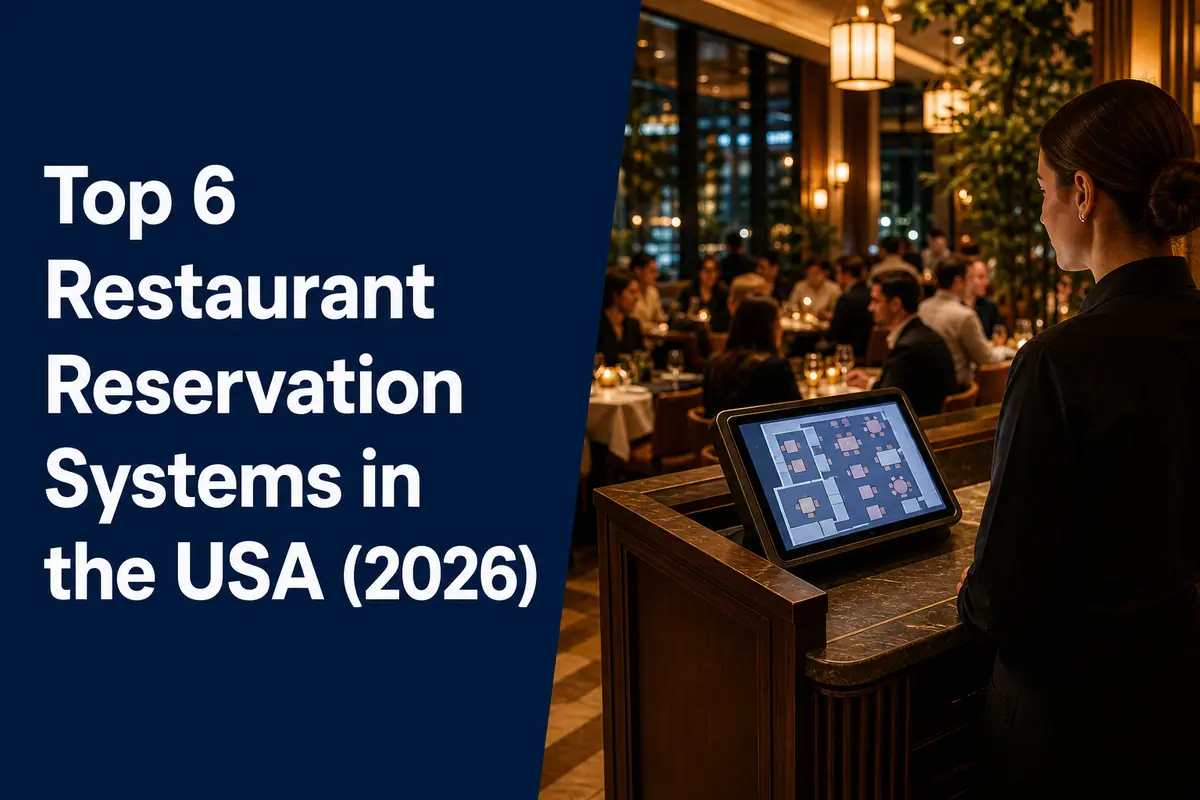
Restaurant reservation software now does far more than place names on a digital book. A capable system can manage the waitlist, pace covers, assign tables, recognize repeat guests, collect deposits, sell experiences and show managers how demand changes by day and channel.
The harder decision is choosing the right commercial model. Some platforms charge a flat monthly subscription. Others may combine subscriptions with per-cover, payment or experience fees. Discovery networks can bring incremental diners, while a direct booking system may give the restaurant greater control over guest data and brand experience.
This guide compares six restaurant reservation systems available in the United States: OpenTable, Resy, Tock, Yelp Guest Manager, Toast Tables and SevenRooms.
Editorial note: ChefPin did not accept payment for inclusion or position in this guide. The systems are organized by best-fit use case, not a universal score. Public details were checked in August 2026. Prices, fees and packages can change, so obtain a dated written proposal before signing.
Quick comparison
| System | Best fit | Public pricing signal | Cover-fee approach | Main consideration |
|---|---|---|---|---|
| OpenTable | Restaurants prioritizing diner discovery | Plans and network charges vary; request a current quote | Network and booking-source fees may apply | Model discovery value against the full cost per seated cover |
| Resy | Hospitality-led restaurants seeking fixed-price reservation tools | Platform $249/month; Platform 360 $399/month | Current pricing page presents fixed monthly plans; processing applies where relevant | Confirm integrations, event tools and exact contract terms |
| Tock | Restaurants selling deposits, events and prepaid experiences | Essential $269/month; Premium $399/month | No standard cover fee; prepayment fees listed at 3% or 2% by plan | Particularly strong when reservations include paid experiences |
| Yelp Guest Manager | Independents wanting reservations, waitlist and broad listing distribution | Basic $129/month annually; Plus $279/month annually | Yelp states there are no cover fees | Basic includes a monthly booked-cover allowance; Plus offers unlimited covers |
| Toast Tables | Restaurants already using Toast POS | Quote required on the current product page | Confirm plan limits and fees in the proposal | Strongest advantage depends on using the Toast ecosystem |
| SevenRooms | Groups focused on guest CRM, direct bookings and marketing | Quote-based | SevenRooms promotes no cover fees on direct reservations | A broader guest-experience platform may be more than a small venue needs |
“No cover fee” does not mean zero cost. Subscription, payment processing, text messaging, deposits, ticketed experiences, hardware, onboarding, integrations and marketing products can still affect the monthly total.
How we evaluated the systems
We looked at the decisions that affect both the host stand and restaurant economics:
- Reservation, waitlist and walk-in management
- Floor plans, table combinations and pacing controls
- Guest profiles, visit history, tags and special-occasion notes
- Discovery reach versus direct booking ownership
- Deposits, credit-card holds, prepayments and cancellation workflows
- POS integration and check-level guest data
- Automated confirmations and two-way messaging
- Experience, event and private-dining capabilities
- Multi-location controls and group reporting
- Subscription, per-cover, processing and add-on costs
- Data access, export and contract exit terms
- Support availability during restaurant service hours
Features were reviewed using vendor materials. A restaurant should still test its own floor plan, turn times and busiest shift before selecting a platform.
1. OpenTable: best for restaurants prioritizing diner discovery
OpenTable for Restaurants combines reservation and table management with a large consumer booking marketplace. Restaurants can also receive reservations through their own website and partner channels. The platform includes tools for floor planning, waitlists, guest profiles, reporting, deposits and credit-card holds, depending on the package.
The main buying question is whether discovery produces valuable incremental demand. A restaurant in a competitive dining market may benefit from exposure to diners already searching for a table. An established neighborhood restaurant with strong direct demand may place more value on predictable flat costs and customer ownership.
Where OpenTable stands out
- A well-known consumer discovery and booking network
- Booking availability across OpenTable and partner channels
- Table management, waitlist and guest notes
- Deposits and card holds for no-show protection
- Reporting on reservation sources and cover patterns
What to verify
Request a proposal separating the monthly platform fee, bookings originating on the OpenTable network, reservations from the restaurant's own widget, prepaid-experience charges, payment processing, integrations and optional marketing. Ask how promotional programs affect acquisition cost and whether they can be paused independently.
Calculate the effective cost per completed incremental cover, not the cost per reservation created. Cancellations, no-shows and guests who would have booked directly can otherwise distort the apparent return.
Best fit: a restaurant seeking demand generation and willing to measure marketplace-sourced covers carefully.
2. Resy: best for hospitality-led restaurants wanting fixed monthly plans
Resy OS supports reservations, waitlists, table management, guest messaging, profiles, reports and diner discovery through Resy. It is associated with a hospitality-focused consumer brand and is used by restaurants ranging from neighborhood operators to high-demand dining rooms.
The current official pricing presentation lists Platform at $249 per month and Platform 360 at $399 per month, with standard payment processing applying where relevant. Platform 360 adds more advanced reservation, event and guest-insight capabilities.
Where Resy stands out
- Fixed monthly plan positioning
- Reservation, waitlist and table-management workflows
- Guest messaging and profile information
- Consumer discovery through Resy
- Higher-tier event and guest-insight capabilities
What to verify
Ask which POS integrations are supported for your exact setup, whether check details flow into guest profiles, and which communication, event or reporting features require Platform 360. Confirm onboarding, hardware, payment processing, contract length and cancellation terms.
The host team should test pacing rules and table combinations. A visually attractive reservation book is not enough if availability opens too aggressively and overwhelms the kitchen.
Best fit: an independent or growing restaurant that values a hospitality-oriented brand, diner network and predictable subscription structure.
3. Tock: best for deposits, experiences and prepaid events
Tock treats reservations as one part of a broader hospitality commerce platform. Restaurants can manage ordinary reservations alongside deposits, prepaid dining experiences, event tickets, waitlists and takeout.
Its official pricing page currently lists:
- Essential: $269 per month with a 3% fee on prepayments
- Premium: $399 per month with a 2% fee on prepayments
Standard payment processing also applies. Tock states that it does not charge standard cover fees. Premium adds capabilities such as POS integrations and premium support.
Where Tock stands out
- Deposits and variable-price prepaid reservations
- Ticketed events, experiences and takeout
- Reservation, waitlist and table management
- Guest data and reports
- Flat subscription plus clearly presented prepayment percentages
What to verify
Model how much of your business will be prepaid. A $399 plan with a lower prepayment percentage can cost less than the $269 plan at sufficient prepaid volume, but only if Premium's other terms fit. Add payment processing and refund exposure to the calculation.
Ask how the system handles partial refunds, date transfers, guest credits, taxes, service charges and event capacity. Review accounting exports before launching prepaid experiences.
Best fit: fine-dining restaurants, tasting-menu concepts, wineries, pop-ups and venues that regularly monetize special experiences or need deposits to manage scarce inventory.
4. Yelp Guest Manager: best for flat-fee front-of-house tools and listing reach
Yelp Guest Manager combines reservations, online waitlists, table management, texting and visibility across Yelp and selected external channels. Yelp says its plans do not charge cover fees.
Current public pricing shows:
- Basic: $129 per month when billed annually or $159 monthly
- Plus: $279 per month when billed annually or $349 monthly
- Enterprise: custom pricing
Basic includes up to 500 booked covers per month, while Plus lists unlimited monthly covers, a guestbook, floor-plan tools, credit-card holds and POS integration. The precise feature comparison matters: a low subscription is not useful if the venue quickly exceeds the plan allowance or requires several Plus-only functions.
Where Yelp Guest Manager stands out
- Public, predictable monthly prices
- No cover-fee positioning
- Reservations and online waitlist
- Booking reach through Yelp, Google Search, Apple Maps and social channels
- Two-way texting and front-of-house reporting
- iPad included with subscription, subject to current terms
What to verify
Confirm how the Basic cover limit is measured and what happens at the threshold. Ask which POS systems integrate with Plus, whether the iPad must be returned, and how guest email and phone data can be exported.
Yelp also offers advertising, a check-in kiosk, guest surveys and an AI phone product. Price these separately and judge each on its own return rather than accepting a bundle simply because the reservation subscription appears inexpensive.
Best fit: an independent restaurant wanting a reservation-and-waitlist system with flat pricing and consumer reach beyond its own website.
5. Toast Tables: best for restaurants already using Toast POS
Toast Tables connects reservations, experiences, waitlists and table management with Toast's restaurant operating system. The product can import a floor plan and server roster, display table and order status, support server rotations and carry guest information into connected Toast workflows.
This integration is the primary reason to shortlist Toast Tables. Hosts can see whether a seated table has ordered or whether items have been fulfilled without relying on radio calls or walking the floor. Guest notes and visit information can also connect with the broader Toast environment.
Toast's current product page directs restaurants to request a demo and quote rather than displaying a complete price table. Treat third-party price summaries as screening information only; use the actual dated Toast proposal for comparison.
Where Toast Tables stands out
- Native relationship with Toast POS and handhelds
- Reservations, waitlist, experiences and table management
- Table and order-status visibility
- Server rotations and cover counts
- Guest profiles, messaging and prepayments
- Booking through a restaurant website, Google and Toast's consumer app
What to verify
Ask about reservation limits, unlimited-booking tiers, experience and prepayment charges, processing, supported tablets, messaging, onboarding and minimum POS requirements. Confirm whether a restaurant can keep Toast Tables if it later changes POS providers.
If the core POS decision is still open, start with ChefPin's comparison of restaurant POS systems in the USA. Reservation integration should support the operating stack, not force a weak POS choice.
Best fit: a Toast restaurant seeking the tightest connection between the host stand, server roster, tables, guestbook and live order status.
6. SevenRooms: best for restaurant groups focused on guest CRM
SevenRooms combines reservations and waitlists with guest CRM, marketing automation, reputation tools, events, table management and group reporting. Its positioning emphasizes direct, commission-free bookings and ownership of the guest relationship.
The platform can build detailed profiles using visit information, preferences, tags and POS spend. For a restaurant group, this can create a shared view of guests across venues and enable targeted follow-up. For a single small restaurant without the staff or strategy to use segmentation and campaigns, that breadth may be unnecessary.
Pricing is quote-based. Compare the complete platform with the combined cost of the reservation, CRM, email, text and reputation tools it may replace.
Where SevenRooms stands out
- Direct, branded reservations and waitlists
- No-cover-fee positioning on direct bookings
- Guest CRM, segmentation and marketing automation
- POS data connections and spend-aware profiles
- Events, experiences, add-ons and online payments
- Multi-venue booking and group reporting
What to verify
Request module-level pricing, messaging allowances, payment fees, onboarding, integrations and multi-location charges. Ask which guest fields can be exported, how consent is recorded and whether marketing tools remain usable after cancellation.
Have the vendor demonstrate a complete workflow: reservation creation, seating, POS check association, guest-profile update, feedback capture and a targeted follow-up campaign. This reveals whether “single guest view” is operational or merely a sales phrase.
Best fit: multi-location restaurants and hospitality groups with a clear strategy for direct bookings, guest data and retention marketing.
How to calculate the real monthly cost
Use the same formula for every proposal:
Monthly reservation cost = subscription + cover charges + payment/prepayment fees + messaging + integrations + add-ons + onboarding amortization + internal labor
Then divide by completed seated covers attributed to the system, not reservations booked.
Build separate figures for:
- Direct website reservations
- Vendor marketplace or discovery reservations
- Walk-ins managed by the waitlist
- Deposited reservations
- Prepaid events and experiences
- Cancelled and refunded bookings
Discovery is valuable only when it creates profitable incremental diners. Direct channels are valuable only when the restaurant can generate traffic and use the guest relationship responsibly. Most operators need both, but the right balance differs by market and concept.
Questions to ask every reservation vendor
Send the same questionnaire to every provider:
- What is the monthly charge per location and per brand?
- Which bookings create cover, transaction or marketplace fees?
- Are website-widget reservations priced differently from network bookings?
- What payment processing and prepayment fees apply?
- Are SMS confirmations and two-way messages included?
- Is there a cover, message, user or device allowance?
- Which POS versions integrate, and what data moves in each direction?
- Can the platform track walk-ins and reservations in one floor plan?
- How does it control pacing, turn times and table combinations?
- Can we hold cards, collect deposits and sell prepaid experiences?
- Who handles chargebacks, refunds and diner disputes?
- Can we export guest, consent, reservation and visit data?
- What discovery channels are included without additional advertising?
- Does the contract auto-renew, and when is cancellation notice due?
- What support is available on Friday and Saturday evenings?
- What data and booking widgets remain available after cancellation?
A practical live-demo test
Ask each vendor to recreate one busy shift using your actual floor plan. Include:
- A two-top that becomes part of a six-top later in service
- A guest moving from the bar waitlist to a dining table
- A late arrival whose table is needed for the next turn
- A VIP with an allergy and seating preference
- A deposit that must be partially refunded
- A walk-in party joining remotely and arriving early
- A server section change during service
- A temporary kitchen slowdown requiring reduced booking pace
Score the system from 1 to 5 for host speed, floor clarity, pacing controls, guest communication, manager reporting, data access and total cost. Let the lead host participate in the decision; a platform that slows down the door will not succeed regardless of executive features.
Implementation checklist
- Rebuild the current floor plan and verify every table combination.
- Define realistic turn times by party size, daypart and service type.
- Set online pacing separately from total restaurant capacity.
- Write cancellation, deposit, late-arrival and no-show policies.
- Review payment, tax and policy wording with qualified advisers.
- Clean and import guest data only with an appropriate legal basis.
- Connect the POS and test check-to-profile matching.
- Configure confirmations, reminders and two-way messaging.
- Train hosts on overrides, outages and duplicate profiles.
- Run a closed test shift before opening online inventory.
- Monitor seated covers, no-shows, channel mix and acquisition cost weekly.
- Review permissions and data exports regularly.
Reservation demand also affects staffing. Use ChefPin's restaurant employee scheduling software comparison to connect expected covers with labor planning. When additional hosts or service staff are needed, start with a clear restaurant job description template.
Which reservation system should you shortlist?
- OpenTable: prioritize it when consumer discovery is central and you will measure incremental covers carefully.
- Resy: consider it for a hospitality-led experience and fixed monthly plan structure.
- Tock: choose it when deposits, tasting menus and ticketed events are major revenue channels.
- Yelp Guest Manager: shortlist it for public flat pricing, waitlist tools and broad listing distribution.
- Toast Tables: evaluate it first if your restaurant already operates on Toast POS.
- SevenRooms: consider it when guest CRM, direct marketing and group-level data are strategic priorities.
There is no universal winner. The best system fills profitable tables, keeps the host stand calm, protects guest data and gives management a cost structure it can explain.
Frequently asked questions
What is the cheapest restaurant reservation system?
Among the public plans in this comparison, Yelp Guest Manager Basic lists the lowest annual-billing starting price. However, its included-cover allowance and feature set differ from other platforms. Compare the plan that satisfies your actual needs, not only the lowest advertised subscription.
Are per-cover fees always bad?
No. A per-cover model can be worthwhile when a discovery network brings profitable guests the restaurant would not have acquired directly. It becomes inefficient when the restaurant pays repeatedly for diners who would otherwise book through its own website.
Should restaurants require a deposit?
Deposits can reduce the financial risk of no-shows for high-demand tables, tasting menus and special dates. The policy should be easy to understand, consistently applied and reviewed for applicable consumer, tax and payment requirements.
What is the difference between a reservation and a waitlist?
A reservation promises availability at a future time subject to restaurant policy. A waitlist estimates when a table may become available for guests who are waiting or planning to arrive. A good platform manages both against the same live floor.
Does reservation software replace a host?
No. It reduces manual work and improves visibility, but hosts still manage exceptions, pacing, guest expectations and the human welcome. The strongest systems help the team make faster decisions without hiding important context.
How often should a restaurant review its reservation platform?
Review weekly operating metrics and conduct a formal commercial review at least annually. Track completed covers, no-show rate, direct-versus-marketplace mix, acquisition cost, table utilization, guest-return rate and support performance.
Product and pricing information was checked on August 8, 2026. This article provides general operational information, not legal, tax, privacy, payment-security or financial advice. Confirm current terms with each vendor and seek qualified advice where appropriate.