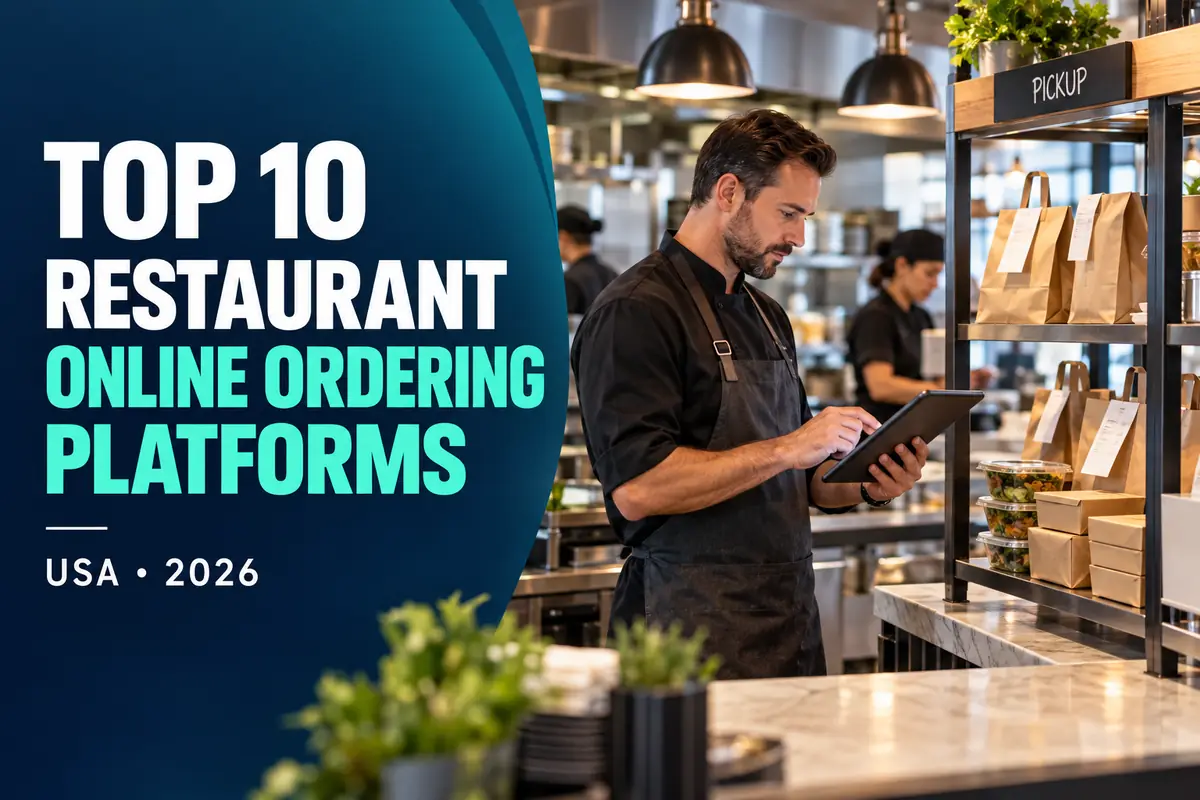
Choosing restaurant online ordering platforms is not a matter of copying another operator’s technology stack. A useful shortlist begins with the restaurant’s service model, locations, transaction volume, existing POS and the exact workflow that needs improvement. This US guide compares ten credible options using public vendor information and practical restaurant buying criteria.
Pricing and editorial disclosure: Prices and plan information were checked on official vendor pages on September 27, 2026. Prices are in US dollars unless another currency is stated. Promotional prices are not treated as normal long-term cost. Quote-only products are labeled instead of being assigned guessed prices. No vendor paid for inclusion or position. The numbering organizes the guide by use case; it is not a universal best-to-worst ranking.
Important: A “zero commission” offer can still include subscription, processing, delivery, marketplace, setup and marketing fees. Calculate cost per completed order at realistic volume.
Top 10 Restaurant Online Ordering Platforms comparison
| Platform | Public price checked | Best fit |
|---|---|---|
| Toast Online Ordering | Custom package pricing | Restaurants using Toast POS |
| ChowNow | Current plan pricing available from sales | Independent restaurants prioritizing direct orders |
| Square Online | Free entry plan; paid plans and payment processing apply | Small restaurants using Square |
| DoorDash Storefront | No marketplace commission on eligible direct orders; processing and delivery fees can apply | Operators wanting direct ordering plus DoorDash logistics |
| Olo | Custom quote | Enterprise restaurant brands |
| Owner.com | Published/package pricing changes; request current proposal | Independent restaurants wanting an all-in-one growth package |
| Popmenu | Custom quote | Website, ordering and marketing together |
| BentoBox | Custom quote | Design-led restaurant websites and commerce |
| GloriaFood | Core online ordering is free; optional paid services and payment processing apply | Budget-conscious independents |
| Flipdish | Custom quote | Multi-channel branded ordering |
Public prices are useful for screening, but plans are not feature-equivalent. Ask every finalist for a written first-year and renewal-year total using the same locations, users, devices, transactions and integrations.
1. Toast Online Ordering — best for restaurants using toast pos
Toast integrates first-party ordering with menus, kitchen routing, payments and guest tools in its restaurant platform.
Published pricing: Custom package pricing. Pricing may exclude taxes, promotions, implementation, hardware, payment processing, messages, integrations and pass-through fees unless explicitly stated by the vendor.
Best for: Restaurants using Toast POS.
Check before buying: Request the software, processing, delivery, hardware, implementation and contract costs in writing.
2. ChowNow — best for independent restaurants prioritizing direct orders
ChowNow provides branded direct ordering, marketing and optional marketplace visibility without the traditional marketplace-commission model.
Published pricing: Current plan pricing available from sales. Pricing may exclude taxes, promotions, implementation, hardware, payment processing, messages, integrations and pass-through fees unless explicitly stated by the vendor.
Best for: Independent restaurants prioritizing direct orders.
Check before buying: Confirm setup, monthly plan, processing, delivery, app and marketing charges.
3. Square Online — best for small restaurants using square
Square combines a website and online ordering with payments, POS synchronization, pickup and delivery options.
Published pricing: Free entry plan; paid plans and payment processing apply. Pricing may exclude taxes, promotions, implementation, hardware, payment processing, messages, integrations and pass-through fees unless explicitly stated by the vendor.
Best for: Small restaurants using Square.
Check before buying: Compare processing rates, feature gates, domain, delivery dispatch and restaurant-specific menu needs.
4. DoorDash Storefront — best for operators wanting direct ordering plus doordash logistics
Storefront places a direct ordering channel on the restaurant’s site while optionally using DoorDash delivery infrastructure.
Published pricing: No marketplace commission on eligible direct orders; processing and delivery fees can apply. Pricing may exclude taxes, promotions, implementation, hardware, payment processing, messages, integrations and pass-through fees unless explicitly stated by the vendor.
Best for: Operators wanting direct ordering plus DoorDash logistics.
Check before buying: Separate Storefront costs from Marketplace commissions, DashPass promotions and delivery fees.
5. Olo — best for enterprise restaurant brands
Olo supports ordering, payments, dispatch and guest engagement for large restaurant organizations.
Published pricing: Custom quote. Pricing may exclude taxes, promotions, implementation, hardware, payment processing, messages, integrations and pass-through fees unless explicitly stated by the vendor.
Best for: Enterprise restaurant brands.
Check before buying: Request prices by module, location, transaction, implementation, support and integration.
6. Owner.com — best for independent restaurants wanting an all-in-one growth package
Owner.com combines a website, ordering, branded app, marketing and guest tools in a managed offering.
Published pricing: Published/package pricing changes; request current proposal. Pricing may exclude taxes, promotions, implementation, hardware, payment processing, messages, integrations and pass-through fees unless explicitly stated by the vendor.
Best for: Independent restaurants wanting an all-in-one growth package.
Check before buying: Model subscription and per-order costs; clarify processing, delivery, contract and cancellation terms.
7. Popmenu — best for website, ordering and marketing together
Popmenu combines an interactive website, online ordering and guest marketing for restaurants.
Published pricing: Custom quote. Pricing may exclude taxes, promotions, implementation, hardware, payment processing, messages, integrations and pass-through fees unless explicitly stated by the vendor.
Best for: Website, ordering and marketing together.
Check before buying: Request separate costs for website, ordering, processing, delivery, marketing and setup.
8. BentoBox — best for design-led restaurant websites and commerce
BentoBox offers restaurant websites and first-party commerce tools, including ordering and events depending on package.
Published pricing: Custom quote. Pricing may exclude taxes, promotions, implementation, hardware, payment processing, messages, integrations and pass-through fees unless explicitly stated by the vendor.
Best for: Design-led restaurant websites and commerce.
Check before buying: Confirm transaction fees, payments, menu migration, integrations and ongoing content services.
9. GloriaFood — best for budget-conscious independents
GloriaFood offers an online ordering widget with optional branded apps, online payments, marketing and other upgrades.
Published pricing: Core online ordering is free; optional paid services and payment processing apply. Pricing may exclude taxes, promotions, implementation, hardware, payment processing, messages, integrations and pass-through fees unless explicitly stated by the vendor.
Best for: Budget-conscious independents.
Check before buying: Price every optional module and confirm support, POS integration and ownership of customer data.
10. Flipdish — best for multi-channel branded ordering
Flipdish provides websites, apps, kiosks, loyalty and ordering tools for restaurant and hospitality operators.
Published pricing: Custom quote. Pricing may exclude taxes, promotions, implementation, hardware, payment processing, messages, integrations and pass-through fees unless explicitly stated by the vendor.
Best for: Multi-channel branded ordering.
Check before buying: Ask about subscription, setup, transaction, processing, hardware, delivery and support fees.
How we evaluated these platforms
ChefPin considered commission structure, payment processing, branded ordering, menu sync, delivery options, customer-data access, marketing, POS integration and uptime. We also favored vendors that explain what is included, support exports and make it possible to test the real restaurant workflow before a long contract.
This list mixes restaurant-specific products with broader platforms because the best choice depends on the problem. A specialist tool may deliver a faster setup, while a flexible general system may be less expensive or fit an existing technology stack.
Build a true-cost comparison
Ask each vendor to complete the same cost worksheet:
- Base subscription and the billing unit: company, brand, location, user, device or transaction.
- Required implementation, data migration, configuration and staff training.
- Hardware, replacements, warranties, shipping and installation.
- POS, payroll, accounting, payments, API and other integration charges.
- Usage charges for messages, checks, covers, payouts, orders or payments.
- Contract length, automatic renewal, annual increase, cancellation and data export.
- Support hours, response targets and the price of premium support.
For a restaurant group, calculate cost at today’s size and again at the expected location count in 24 months. A cheap pilot that becomes expensive at scale can create a difficult migration later.
Run a restaurant pilot before signing
Use one representative location for at least two operating cycles. Include a busy shift, a manager handoff, a correction and an internet or device failure where relevant. Let frontline employees complete the workflow without a vendor representative coaching them. Record completion time, errors, manager follow-up and any duplicate entry.
The pilot should answer four questions: Will employees actually use it? Can managers see exceptions quickly? Does it exchange reliable data with the existing stack? Can the restaurant retrieve its own records in a useful format?
If the product touches employees, connect the rollout to a clear job description and onboarding process. ChefPin’s restaurant and hotel job-description template can help define ownership. Operators can also hire chefs and kitchen professionals, while candidates can browse chef and hospitality jobs.
For adjacent technology decisions, compare ChefPin’s restaurant recruitment software guide, US restaurant payroll and HR platforms, restaurant scheduling apps and restaurant employee-training software.
Questions to ask during every demo
- Which quoted features are generally available today rather than on the roadmap?
- What is the exact price for our locations, users, devices and volume after promotions end?
- Which integrations are native, which use third parties and who supports failures?
- Can we export complete records in a documented format without professional services?
- How are permissions, approvals, edits and deletions recorded?
- What happens during internet, payment, POS or device outages?
- What implementation work belongs to the restaurant, and what does the vendor perform?
- Can the vendor provide two references with a similar restaurant format and location count?
Frequently asked questions
What is the best restaurant online ordering platforms for a restaurant?
There is no universal winner. Start with the “best fit” column, eliminate products that cannot integrate with required systems, then compare two or three finalists in a live pilot using the same scorecard.
Should a restaurant choose the least expensive plan?
Not automatically. A lower subscription can cost more if it creates duplicate work, lacks needed controls or adds transaction and integration fees. Compare total cost and measurable operating impact.
How often should restaurant software be reviewed?
Review performance and user access quarterly, and conduct a formal value, security, pricing and renewal review at least 90 days before the contract renews.
Are the prices in this guide guaranteed?
No. They are a dated snapshot of public vendor information. Vendors can change plans, promotions and fees. Obtain a written quote and order form before buying.
Final recommendation
Create a two- or three-vendor shortlist, request like-for-like pricing and run a real-location pilot. Select the platform that employees can use consistently, managers can audit quickly and the business can afford after every required fee—not the product with the longest feature list.