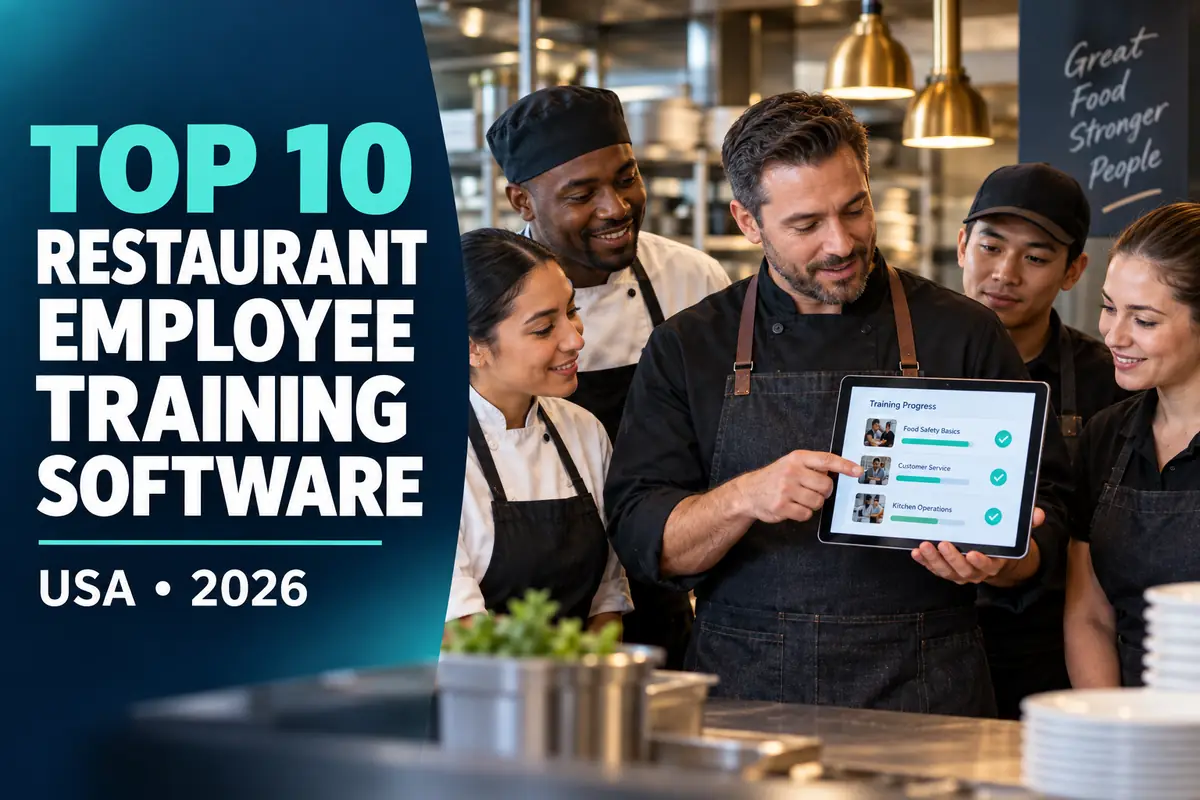
Restaurant training is difficult to standardize because employees work different shifts, learn different stations and may rarely sit at a desk. A useful training platform should do more than host videos: it should assign role-based learning, document completion, support practical sign-offs and make current procedures easy to find during a shift.
This guide compares 10 employee-training software platforms available to restaurants in the United States. It covers restaurant-specific systems and flexible learning-management systems, with public prices wherever vendors publish them.
Pricing and editorial disclosure: Prices were checked on official vendor pages on September 24, 2026. US-dollar prices exclude tax, promotions, optional content, implementation and integrations unless stated. Typsy currently displays its public Team price in euros. Quote-only products are labeled instead of being assigned guessed prices. No vendor paid for inclusion or position. The numbering organizes the guide by use case; it is not a universal best-to-worst ranking.
Restaurant employee training software comparison
| Platform | Public price checked | 25-employee planning example | Best fit |
|---|---|---|---|
| Typsy | Team: €120/member/year | €3,000/year, or €250/month equivalent | Ready-made hospitality and restaurant learning |
| Opus | Custom quote | Request a quote | Mobile-first frontline training and multilingual SOPs |
| R365 Training | Custom quote | Request a quote | Restaurant groups using Restaurant365 or ExpandShare |
| Wisetail | Custom quote | Request a quote | Branded training, communications and multi-unit operations |
| Schoox | Custom quote | Request a quote | Franchise and enterprise restaurant learning |
| Trainual | Custom quote; $1,000 implementation fee stated | Request a quote plus implementation | SOP documentation and role-based onboarding |
| TalentLMS | Free up to 5 users; Core $119/month annually or $149 monthly for up to 40 | $119/month equivalent annually, or $149 monthly | Small groups building their own LMS |
| 360Learning | Team: $8/user/month, up to 100 | $200/month | Collaborative course creation by internal experts |
| SafetyCulture | Free up to 10; Premium full seat $24/month and Lite $5/month annually | Illustrative: $144/month for 1 Full + 24 Lite seats | Training combined with checklists and operational controls |
| Axonify | Custom quote | Request a quote | Enterprise frontline microlearning and reinforcement |
The 25-person examples are budgeting illustrations, not feature-equivalent quotes. A platform with a course library may replace content purchases, while a lower-priced LMS may require the restaurant to create every lesson. Compare total first-year cost and operational fit, not only the subscription.
1. Typsy — best hospitality-specific content library
Typsy is built for hospitality learning. Its library covers service, culinary, beverage, compliance, management and hotel topics through short lessons, courses, assessments and credentials. The Team plan adds the ability to assign learning and view workforce capability, while Enterprise targets large groups that need integrations and more centralized control.
Published price: Individual costs €180 per year. Team costs €120 per member per year for up to 100 members. Enterprise is custom priced. For 25 Team members, the public calculation is €3,000 per year, equivalent to €250 per month before tax. The pricing page displays euros, so US operators should confirm billing currency and taxes before purchasing.
Best for: Restaurants and hospitality businesses that want a ready-made industry course library rather than creating all training from zero.
Check before buying: Review the exact courses needed for kitchen, service, bar and management roles. Confirm which custom-content, reporting, translation and integration functions require Enterprise or additional fees.
2. Opus — best for multilingual frontline training
Opus focuses on restaurant and service employees who learn on mobile devices. It combines training modules, a searchable resource library, multilingual delivery, reporting and restaurant-oriented compliance options. Growth adds an LMS, assessments, AI-assisted course building, HRIS connections and wage-and-hour features. Enterprise adds more integrations, permissions and implementation support.
Published price: Opus lists Core, Growth and Enterprise plans but does not publish dollar amounts. All plans advertise unlimited users and admins, while the feature scope varies. Volume discounts are mentioned; restaurants need a written proposal.
Best for: Multi-location restaurants that need mobile learning and translated SOPs for a linguistically diverse frontline workforce.
Check before buying: Ask what drives the quote—locations, active employees, brands, modules or contract term. Separate platform, implementation, compliance-course, checklist, audit and integration charges.
3. R365 Training — best for Restaurant365 customers
R365 Training, previously known as ExpandShare, is a restaurant employee-training product from Restaurant365. It supports learning tracks, role assignments, course deadlines, quizzes, progress reporting, trainer checks, a searchable library, news posts and mobile access. Restaurant365 also maintains a marketplace of restaurant courses and checklists, including food safety, allergens, guest service and management topics.
Published price: Custom quote. Restaurant365 does not display a standalone R365 Training subscription price on its public pricing page.
Best for: Restaurant groups that already use Restaurant365 and want employee training connected to a broader restaurant operations platform.
Check before buying: Request separate figures for the training platform, marketplace courses, implementation, content conversion, HR or payroll integration and other R365 modules. Confirm data-export rights and the cost of adding locations.
4. Wisetail — best for branded learning and communications
Wisetail combines an LMS with communications, resources, social learning and operational checklists. Restaurant teams can create role-based training, quizzes, flashcards and observational assignments, while multi-language and mobile features help distribute consistent information across locations.
Published price: Custom quote. Wisetail's public pricing page asks businesses to request a proposal based on their learning and operational needs. It describes dedicated implementation and client-success services but does not publish a standard subscription fee.
Best for: Established restaurant brands wanting a strongly branded employee experience that combines training, internal communication and day-to-day guidance.
Check before buying: Ask whether pricing is based on locations, registered users or active learners. Obtain prices for implementation, branding, professional content services, integrations, offline access and support.
5. Schoox — best for franchise and enterprise structures
Schoox provides learning paths, certifications, blended learning, reporting, communications, skills development and multiple-language support. Its restaurant product is designed to mirror complex organizations by brand, franchise, region, location, department or role. It also integrates with restaurant-content providers and can connect with other systems through APIs.
Published price: Custom quote. Schoox directs buyers to request a demonstration and does not publish a restaurant subscription rate.
Best for: Franchise systems and larger restaurant organizations that need granular permissions, certifications and reporting across many operating units.
Check before buying: Give the vendor an accurate organization map. Ask how franchisees, shared employees, external learners and separate brands affect licensing. Price content libraries, implementation, integrations and reporting services independently.
6. Trainual — best for documenting SOPs and onboarding
Trainual brings training, policies, procedures, roles and company knowledge into one system. Restaurants can convert operating procedures into step-by-step subjects, add videos and quizzes, assign training by role or location and track completion. Its value is strongest when the problem is scattered knowledge as well as formal learning.
Published price: Trainual offers Core, Pro, Premium and Enterprise but now requires a sales quote based on team size and features. Its pricing page states that a one-time $1,000 implementation fee applies. Optional premium courses may add cost.
Best for: Independent groups and growing concepts that need to document recipes, opening procedures, service standards and management processes while onboarding employees.
Check before buying: Request the subscription, implementation, content-library and renewal prices in writing. Confirm video storage, e-signatures, SCORM, custom branding, SSO and integrations in the quoted tier.
7. TalentLMS — best transparent-price general LMS
TalentLMS is a general learning-management system rather than a restaurant-specific product. It supports courses, quizzes, certificates, learning paths, branches, automations, reports, gamification, integrations and AI-assisted content creation. Restaurants supply their own operating content or purchase third-party libraries.
Published price: A free plan supports up to five users and 10 courses. Core starts at $119 per month for up to 40 registered users when billed annually, paid as $1,428 upfront. The current monthly Core price is $149. Grow starts at $229 per month annually for up to 70 users, and Pro starts at $449 per month annually for up to 100. Optional content and flexible-user limits may add cost.
For a 25-person restaurant, Core is $119 per month equivalent on annual billing or $149 on month-to-month billing.
Best for: Smaller restaurant groups that want predictable LMS pricing and can create or source their own restaurant content.
Check before buying: Core includes one branch. Groups separating concepts or franchisees may require Grow, Pro or Enterprise. Price TalentLibrary and any external restaurant-compliance content separately.
8. 360Learning — best for collaborative course creation
360Learning is designed around internal experts creating and improving courses together. Restaurant operators can use chefs, beverage leaders, trainers and general managers as subject-matter authors rather than sending every update through one learning administrator. The Team plan includes core LMS functions, AI-assisted authoring, course management and collaborative learning.
Published price: Team costs $8 per user per month for up to 100 users, with monthly billing, no long-term commitment and no setup fee. Optional solutions cost another $2 per user per month per solution. Business and Enterprise use custom pricing.
For 25 users, the base Team calculation is $200 per month. One $2 add-on for every user would add $50 per month.
Best for: Restaurant groups that want operational experts to build training collaboratively and update it quickly.
Check before buying: Clarify what counts as an active user, which integrations and support levels require Business or Enterprise and how add-ons change the final monthly cost.
9. SafetyCulture — best for training plus operational checklists
SafetyCulture combines workplace training with inspections, checklists, tasks, issue reporting and operational records. Its mobile learning tools include an AI course builder, a course library, in-person training records, performance tracking and recurring courses. That combination can connect learning to opening checks, cleaning procedures and food-safety routines.
Published price: Free is available for up to 10 seats. On annual billing, Premium Full seats are $24 per seat per month and Lite seats start at $5. Full seats can manage and publish training; Lite seats can create and complete training but have narrower platform permissions.
An illustrative 25-person setup with one Full administrator and 24 Lite learners is $144 per month on annual billing: $24 + (24 × $5). A restaurant needing several Full managers will pay more. Confirm the exact seat mix with SafetyCulture.
Best for: Restaurants that want staff training, checklists, inspections, issue reporting and tasks within one operations platform.
Check before buying: Map managers and employees to seat types before calculating price. Verify which people must publish courses, manage groups, view reports or administer inspections.
10. Axonify — best for enterprise microlearning and reinforcement
Axonify is a frontline learning platform built around short, repeated and personalized training. It combines assigned paths, onboarding, self-directed resources, gamification, reinforcement and analytics. The approach can suit restaurant enterprises that need employees to practice critical knowledge in brief sessions rather than complete long desktop courses.
Published price: Custom quote. Axonify does not publish standard subscription rates on its public platform pages.
Best for: Large restaurant and hospitality employers investing in continuous frontline learning, knowledge reinforcement and engagement.
Check before buying: Request an itemized first-year and renewal proposal for licensing, implementation, content, integrations, support and optional engagement tools. Ask the vendor to model seasonal turnover and inactive learners.
Public-price examples for a 25-person restaurant
These examples use the smallest publicly listed configuration that can accommodate 25 employees. They are not equivalent in course libraries, implementation or features.
| Platform | Calculation | Monthly equivalent | Billing note |
|---|---|---|---|
| TalentLMS Core annual | Flat rate up to 40 users | $119 | $1,428 paid annually |
| SafetyCulture mixed seats | 1 Full × $24 + 24 Lite × $5 | $144 | Annual billing; validate seat permissions |
| TalentLMS Core monthly | Flat rate up to 40 users | $149 | Monthly billing |
| 360Learning Team | 25 × $8 | $200 | Monthly billing; add-ons excluded |
| Typsy Team | 25 × €120 ÷ 12 | €250 | €3,000 billed annually |
The remaining five platforms require proposals. A custom quote is not automatically expensive, but it must be detailed enough to compare. Require the vendor to state included learners, locations, admins, content, implementation, support, integrations, contract term and renewal price.
Essential restaurant-training capabilities
Role- and station-based learning
A new line cook, server, barista and assistant manager should not receive the same path. The platform should assign training by role, station, concept and location while preserving common company orientation.
Practical sign-offs
Watching a knife-skills or closing-procedure video does not prove practical competence. Look for trainer observations, checklists, assessments or manager sign-offs that connect digital instruction with work on the floor.
Mobile and multilingual access
Restaurant employees often train from a phone in short windows. Test the learner experience on an ordinary mobile device and weak connection. Confirm whether translations cover both the interface and restaurant-created content.
Version control and audit records
When a recipe, allergen procedure or policy changes, managers need to know who received the new version. The system should preserve publication dates, assignments, acknowledgements, test results and certificate expiration.
Searchable knowledge during shifts
An employee may need one answer, not an entire course. Evaluate whether recipe cards, cleaning procedures and guest-service guidance can be searched quickly without exposing unrelated administrative content.
Integrations and user lifecycle
Training accounts should follow hires, transfers, promotions and departures. Ask whether the platform can sync employees, roles and locations from the restaurant's HR, payroll or scheduling system, and how quickly terminated users lose access.
How to calculate the real first-year cost
Use the same formula for every proposal:
First-year cost = subscription + implementation + content + integrations + internal course-building time + paid training hours
Request written prices for:
- Registered, active and seasonal employees
- Administrators, trainers and franchisees
- Each location, concept and training portal
- Implementation and data migration
- Restaurant course libraries and certifications
- Translation and custom-content production
- HRIS, scheduling, SSO and API integrations
- SMS, storage and AI usage limits
- Support, customer success and service levels
- Contract term, renewal increases and cancellation notice
Also budget employee time. A 20-minute required lesson completed by 300 hourly employees represents 100 paid labor hours before manager follow-up.
A practical restaurant LMS demonstration
Give every vendor the same test rather than accepting a polished generic tour:
- Create roles for line cook, server and general manager at two locations.
- Assign different onboarding paths with one shared orientation lesson.
- Upload a real SOP and turn it into a mobile lesson and quiz.
- Translate the lesson into a language used by the team.
- Add an observed task that a trainer must sign off in person.
- Update the SOP and show how affected employees are reassigned.
- Display completion, overdue training and expiring certification reports.
- Transfer an employee from one location and role to another.
- Archive a departing employee while preserving the audit record.
- Export courses, learner records and completion history.
Ask an actual restaurant manager and hourly employee to try the mobile workflow. Administrator-friendly software can still fail if a learner cannot open a lesson quickly before a shift.
Training should connect with hiring, scheduling and payroll
The training workflow begins before an employee's first shift. Employers can find chefs and hospitality professionals on ChefPin, and candidates can browse restaurant and chef jobs. A structured role description helps turn hiring requirements into an onboarding path; use ChefPin's restaurant and hotel chef job-description template as a starting point.
Technology should then pass the employee cleanly through recruitment, scheduling, training and pay. Compare ChefPin's guides to restaurant recruitment software, restaurant staff scheduling apps and restaurant payroll and HR platforms when designing the complete workflow.
Frequently asked questions
What is the best training software for restaurants?
Typsy is strong for ready-made hospitality courses; Opus, R365 Training, Wisetail and Schoox focus on restaurant or frontline operations; Trainual emphasizes SOPs; TalentLMS and 360Learning offer flexible general LMS options; SafetyCulture connects training with operational checks; and Axonify targets enterprise microlearning. The best choice depends on team size, content needs and existing systems.
How much does restaurant employee-training software cost?
Public examples for 25 employees range from $119 per month equivalent for TalentLMS Core on annual billing to $200 per month for 360Learning Team. SafetyCulture's cost depends on the Full and Lite seat mix, while Typsy lists €120 per Team member annually. Many restaurant-focused vendors require custom quotes.
Does training software include food-safety certification?
Not automatically. Some platforms offer or integrate food-safety and allergen courses, but certification eligibility, exams and state acceptance can require separate products and fees. Confirm requirements with the relevant state or local authority.
Can restaurant employees complete training on a phone?
Most platforms in this guide provide mobile-responsive learning or native apps. Test actual lessons, video playback, quizzes, uploads and practical sign-offs on the devices employees use.
Should training be completed before or after clocking in?
Required job training may count as compensable working time under applicable law. Restaurants should establish a compliant policy with qualified HR or legal guidance and ensure training, scheduling and payroll records agree.
What is the difference between an LMS and an SOP platform?
An LMS primarily assigns learning and records completion. An SOP or knowledge platform focuses on current instructions and searchable processes. Several products combine both, but restaurants should test formal learning and in-shift reference separately.
How should a multi-location restaurant manage course updates?
Maintain one controlled master version where possible, use location exceptions only when necessary and record who approved each change. Automate reassignment for material updates and preserve historical completion records.
Final recommendation
Begin with the training problem, not the software category. Restaurants needing ready-made hospitality content should test Typsy. Groups wanting restaurant-native mobile learning should compare Opus, R365 Training, Wisetail and Schoox. Teams documenting their own procedures should consider Trainual, TalentLMS or 360Learning. SafetyCulture is useful when operational checklists belong in the same platform, while Axonify suits large organizations building a continuous-learning program.
Shortlist three products and run the same real SOP, role assignment, translation and practical sign-off in each. Compare the complete first-year and renewal costs. The winning platform should help a new employee become safe, confident and productive—and give managers evidence that the training was understood and applied.