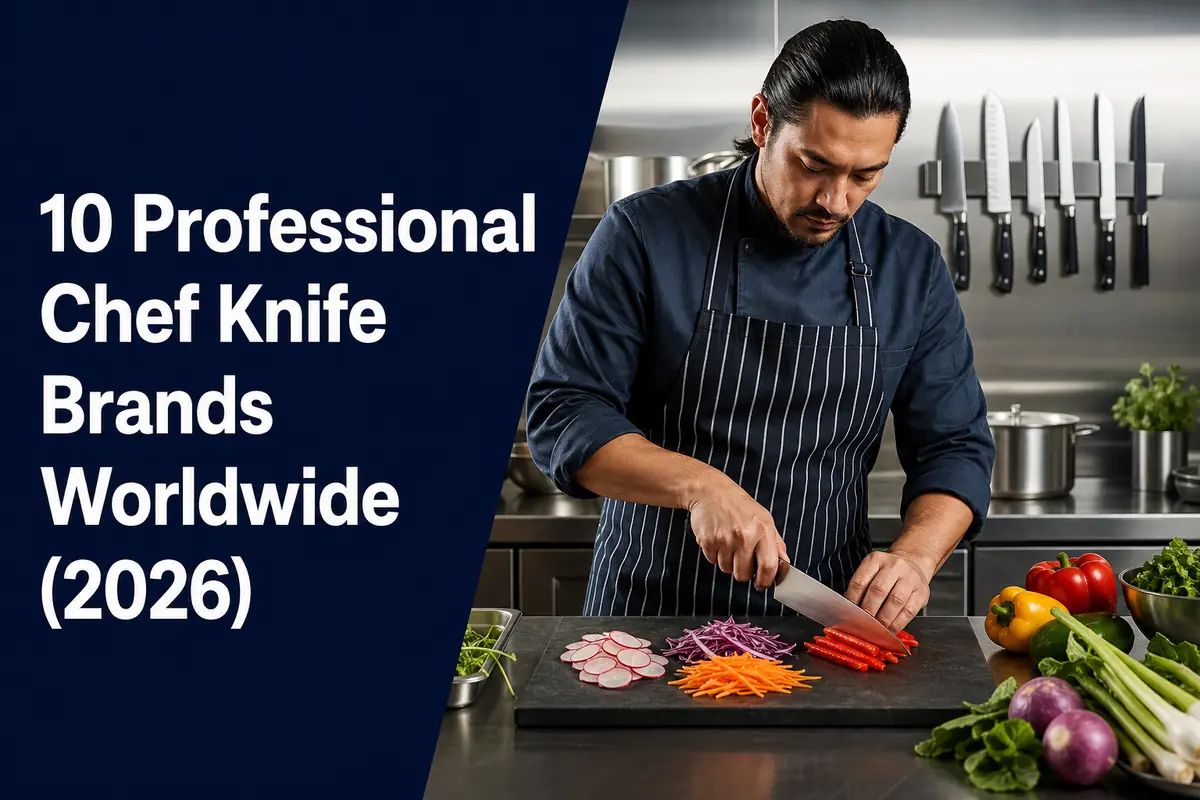
A professional chef's knife is not chosen by logo alone. The right blade must suit the cook's grip, cutting motion, station, sharpening routine and working environment. A light Japanese-style gyuto may feel fast and precise on vegetables, while a heavier Western chef's knife may better suit a cook who prefers a pronounced rocking motion and a more robust edge.
This global guide profiles 10 established professional knife brands: F. DICK, GLOBAL, Kai, MAC, Mercer Culinary, Messermeister, TOJIRO, Victorinox, WÜSTHOF and ZWILLING.
The brands cover different parts of the professional market—from color-coded, slip-resistant foodservice knives to forged premium lines and thin Japanese blades. The goal is to help chefs create a practical shortlist, not crown a universal winner.
Editorial note: ChefPin did not accept payment for inclusion or placement. Brands are listed alphabetically. Product details were checked against official brand materials in August 2026. Prices, warranties, sharpening programs and model availability vary by country. Handle a knife before buying whenever possible.
Quick comparison
| Brand | Best starting fit | Representative professional lines | Main buying consideration |
|---|---|---|---|
| F. DICK | High-volume restaurant, butcher and culinary-school work | ProDynamic, Superior, 1905, Premier Plus | Select handle, blade profile and sharpening steel as one system |
| GLOBAL | Chefs preferring lightweight all-stainless Japanese design | GLOBAL Classic and related series | Metal handles and balance feel distinctive; test wet-hand grip personally |
| Kai | Commercial cooks wanting accessible NSF-oriented work knives or premium Shun options | Kai PRO; Shun Classic, Premier and other Shun series | Kai PRO and Shun serve different budgets and maintenance expectations |
| MAC | Chefs wanting a thin, agile Japanese-made workhorse | Chef, Superior, Professional and Ultimate series | Thin edges cut efficiently but still require suitable boards and technique |
| Mercer Culinary | Culinary students, restaurants and foodservice programs | Millennia, Genesis, Renaissance, ZüM, MX3 and BPX | Broad price and construction range makes model selection especially important |
| Messermeister | Chefs wanting German-style or hybrid professional options | Pro Series, Meridian Elite, Oliva Elite, Custom and Kawashima | Compare stamped work lines with forged premium lines rather than the brand average |
| TOJIRO | Buyers exploring Japanese gyuto and specialty profiles | DP and other Japanese series, subject to local catalogue | Buy from an authorized source and confirm steel, bevel and care for the exact model |
| Victorinox | Value-focused professional kitchens and HACCP workflows | Fibrox, Dual Grip, Swibo, Swiss Classic and Grand Maître | Fibrox and commercial lines emphasize grip and practicality; premium forged lines differ |
| WÜSTHOF | Chefs preferring forged Western balance and rocking profiles | Classic, Classic Ikon, Performer, Gourmet and others | Series vary in construction, bolster, weight and price |
| ZWILLING | Buyers wanting established German forged ranges and several handle/bolster designs | Pro, Professional S and related lines | Try the curved or full bolster because it affects grip and sharpening access |
This table compares brand positioning, not edge performance in a controlled test. Steel treatment, geometry and quality can differ significantly between series from the same manufacturer.
How ChefPin evaluated the brands
We looked for characteristics relevant to working chefs:
- A genuine professional or foodservice product range
- Multiple useful blade lengths and profiles
- Clear construction and material information
- Handles suited to repeated prep work
- Availability through international or regional dealers
- Sharpening, warranty or care guidance
- Options across different career stages and budgets
- Replacement availability if a knife is lost or damaged
- Foodservice features such as slip-resistant or color-coded handles where applicable
This is not a laboratory sharpness test. Factory sharpness changes after the first sharpening, and long-term performance depends heavily on the user, cutting board, edge angle and maintenance routine.
1. F. DICK: professional kitchen and butcher heritage
F. DICK offers chef, butcher and sharpening tools designed around professional use. Its kitchen ranges include economical stamped work knives and more substantial forged series, with chef's knives available in several lengths.
The ProDynamic line is a practical starting point for busy kitchens, while Superior, ActiveCut, 1905 and Premier Plus provide different handle, weight and construction choices. F. DICK also has deep experience with honing steels, which matters because the steel and knife should be compatible.
Why chefs shortlist F. DICK
- Broad range for restaurant and meat-processing work
- Multiple chef's-knife lengths and specialized profiles
- Work-oriented synthetic handles and premium forged options
- Honing steels, cases, guards and related professional tools
- Strong fit for culinary training and standardized kitchen kits
What to check
Compare handle texture after it is wet, heel clearance, spine comfort and the amount of bolster near the edge. Choose a honing tool recommended for the exact blade. A highly aggressive steel can remove more material than a cook expects, while an unsuitable maintenance tool may fail to realign or refresh the edge.
Best fit: chefs, butchers, schools and high-volume kitchens that want a complete working system of knives, steels and storage.
2. GLOBAL: lightweight all-stainless design
GLOBAL was introduced by Japanese manufacturer Yoshikin in 1985. Its knives are visually distinctive because the blade and hollow handle create an all-stainless design with a dotted grip pattern. The brand offers Western and Japanese-inspired blade shapes.
GLOBAL knives often appeal to cooks who want a relatively light, nimble feel and do not want a traditional riveted handle. That same handle design can be polarizing. Hand shape, grip pressure and the way a handle behaves when wet matter more than appearance.
Why chefs shortlist GLOBAL
- Lightweight, recognizable stainless construction
- Broad selection of chef, vegetable, utility and specialist profiles
- Smooth transition between blade and handle
- Established international distribution
- Models used by both professional cooks and serious home users
What to check
Test whether the handle diameter, texture and balance remain comfortable during a long prep session. Confirm the recommended sharpening angle for the chosen series and avoid assuming every sharpener designed for a heavy Western knife is appropriate.
Best fit: chefs who prefer agile all-stainless knives and have personally confirmed that GLOBAL's handle geometry suits their grip.
3. Kai and Shun: commercial work knives and premium Japanese cutlery
Kai Housewares serves more than one market. Kai PRO is positioned for rigorous kitchen use, while the Shun brand offers premium Japanese-style series with different steels, cladding, handles and finishes.
Kai PRO chef's knives use high-carbon stainless steel, full-tang construction and riveted synthetic handles. Selected products are NSF certified for commercial kitchens. Shun lines target buyers seeking finer materials, Japanese aesthetics and more specialized construction, generally at higher prices.
Why chefs shortlist Kai or Shun
- An accessible commercial range through Kai PRO
- Premium Japanese-made choices through Shun
- Chef's knives, santoku, nakiri, utility and specialty profiles
- Published care and sharpening support in major markets
- Different budgets within one manufacturer group
What to check
Do not compare Kai PRO and Shun as if they were one knife line. Confirm blade steel, edge angle, hardness, handle and country of origin for the exact product. Premium hard blades can hold fine edges but may be less forgiving of twisting, frozen food, bones or poor cutting boards.
Best fit: culinary students and working cooks considering Kai PRO, plus chefs wanting a premium Shun after committing to appropriate maintenance.
4. MAC: thin Japanese workhorse profiles
MAC Knife offers Chef, Superior, Professional and Ultimate series. Its chef's knives are known for relatively thin blades intended to reduce wedging through food. The Professional Series includes several chef's-knife lengths and the widely distributed dimpled MTH-style profile.
A thin blade can make repetitive vegetable and protein prep feel efficient because less metal pushes ingredients apart. Thin geometry is not permission to pry, twist or cut through hard bones. Technique and cutting surface remain essential.
Why chefs shortlist MAC
- Thin, agile chef's-knife geometry
- Several lengths and price levels
- Japanese manufacture and Western-friendly profiles
- Professional Series options for daily prep
- Broad availability through specialist culinary retailers
What to check
Compare handle size, blade height, food release and knuckle clearance. Ask whether local authorized sharpening is available and whether the factory edge is asymmetrical on the exact model. Test the knife using the primary cutting motion rather than judging it only by how easily it slices paper.
Best fit: line cooks and chefs who want efficient Japanese cutting geometry in a familiar multipurpose profile.
5. Mercer Culinary: strong range for schools and foodservice
Mercer Culinary offers one of the broadest professional cutlery ranges in this list. Millennia is widely oriented toward practical foodservice use, while Genesis, Renaissance, ZüM and MX3 cover different forged, handle and steel preferences. BPX targets demanding butcher and meat-preparation work.
This range allows a culinary school or restaurant group to choose consistent tools at several budget levels. It also means buyers must compare the specific series rather than rely on the Mercer name alone.
Why chefs shortlist Mercer Culinary
- Professional options for students, restaurants and institutions
- Multiple handle colors and practical synthetic designs in selected lines
- Forged and stamped construction choices
- Chef, butcher, pastry, seafood and specialty knives
- Knife guards, rolls and sharpening tools from the same supplier
What to check
Identify whether the model is stamped or forged, the steel type, hardness, blade angle, handle material and certification. For shared kitchens, consider color control, replacement cost and whether individual knives can be reordered easily for several years.
Best fit: culinary programs, high-volume foodservice and chefs wanting a clear progression from affordable work knives to premium series.
6. Messermeister: German-style and hybrid choices
Messermeister offers Pro Series work knives alongside forged Meridian Elite and Oliva Elite ranges, plus newer hybrid and specialty collections. The brand's catalogue spans affordable synthetic-handled products and premium knives made in different countries.
Messermeister can suit a cook who wants a Western chef's knife without automatically choosing a heavy full-bolster design. Several lines provide different blade thicknesses, handle materials and balance points.
Why chefs shortlist Messermeister
- Professional entry-level and premium collections
- German-style chef's knives in several lengths
- Options with reduced or open heel areas for sharpening
- Synthetic, wood and composite handle choices
- Knife-care education and accessories
What to check
Country of origin, construction and steel vary by collection. Natural wood handles need different care from synthetic handles. Check whether the bolster permits sharpening the entire edge and whether the handle remains stable through repeated sanitation routines.
Best fit: cooks wanting a Western or hybrid profile with several weight, construction and price choices.
7. TOJIRO: accessible route into Japanese profiles
TOJIRO manufactures Japanese kitchen knives across Western-style gyuto, santoku, traditional single-bevel and specialty profiles. The DP series is widely distributed internationally and often serves as an introduction to harder Japanese-style cutlery.
The major buying risk is not the brand but the seller and exact model. Global marketplaces may mix authorized products, parallel imports and incomplete descriptions. Blade steel, layers, handle, bevel and warranty support should be verified against the official model number.
Why chefs shortlist TOJIRO
- Japanese chef and specialty knife profiles
- Broad range across practical and premium levels
- Gyuto options suitable for multipurpose professional prep
- International availability through specialist dealers
- Entry point for cooks moving from softer Western work knives
What to check
Confirm whether the knife is double- or single-bevel, the intended hand orientation, steel, blade length and care needs. Hard, thin edges should not be used for frozen food, hard bones, prying or lateral twisting. Ask who will sharpen the knife locally before buying it.
Best fit: chefs ready to adopt Japanese edge maintenance and seeking a widely available gyuto or specialty profile.
8. Victorinox: practical professional value
Victorinox Commercial Knives includes Fibrox, Dual Grip, Swibo, Swiss Classic, Wood and Grand Maître collections. Fibrox is particularly relevant to professional kitchens because its textured synthetic handles and broad profile selection emphasize repeatable daily use.
Victorinox also offers color choices on selected professional knives to support visual separation in HACCP-based workflows. Its premium Grand Maître products are a different proposition from stamped Fibrox work knives, so the brand can serve both operational purchasing and individual chef preferences.
Why chefs shortlist Victorinox
- Strong value in stamped professional knives
- Slip-resistant synthetic handle choices
- HACCP-oriented colors on selected commercial products
- Meat-processing, foodservice and general kitchen profiles
- Wide global recognition and replacement availability
What to check
Choose blade length and flexibility for the task. A flexible boning knife, stiff chef's knife and broad butcher knife should not be treated interchangeably. Confirm whether the local model and color are approved under the kitchen's purchasing or food-safety system.
Best fit: restaurants, commissaries and individual cooks prioritizing grip, easy replacement and dependable professional value.
9. WÜSTHOF: forged Western tradition
WÜSTHOF offers Classic, Classic Ikon, Performer, Gourmet and other series. Many premium lines use forged German steel and are made in Solingen, while the construction, handle, bolster and price differ between collections.
The traditional Western chef's-knife profile has a curved belly that works well for rocking cuts. Some cooks appreciate its weight and feedback; others prefer a flatter, lighter Japanese profile for push cutting. Neither is universally better.
Why chefs shortlist WÜSTHOF
- Established forged German chef's-knife ranges
- Several handle and bolster designs
- Western profiles suited to rocking cuts
- Broad international retail presence
- Premium and more accessible series
What to check
Compare Classic and Classic Ikon handles in person. Pay attention to the bolster, because a full bolster can affect sharpening access and may create a protruding heel after years of edge removal if not maintained correctly. Confirm that decorative coatings or premium handle materials suit the realities of the workplace.
Best fit: chefs who prefer a balanced, forged Western knife and want wide access to established series.
10. ZWILLING: German forged ranges and varied ergonomics
ZWILLING offers Pro, Professional S and other chef's-knife collections. ZWILLING Pro uses a curved bolster intended to support a pinch grip and make the full edge accessible, while other series offer more traditional shapes.
The company's range also includes Japanese-style Miyabi products, but this guide treats ZWILLING's core chef-knife lines as the primary comparison. Buyers should evaluate the actual factory, steel, hardness and construction shown on each product page.
Why chefs shortlist ZWILLING
- Multiple forged chef's-knife ranges
- German-made options using high-carbon stainless steel
- Curved- and traditional-bolster choices
- Several common blade lengths
- Broad international distribution and supporting accessories
What to check
Try a pinch grip on the curved bolster and compare it with a traditional model. Check handle contour, spine and heel finishing, overall weight and where the balance point falls. Avoid selecting a set until the primary chef's knife has passed a full prep test.
Best fit: chefs wanting a German forged knife with several ergonomic and bolster designs to compare.
How to choose your first professional chef's knife
Start with the work, not the brand.
1. Choose the primary task
For most cooks, a 20–21 cm or 8-inch chef's knife or gyuto handles the widest range of preparation. A pastry cook, butcher, sushi chef or fish cook may need a different first purchase.
2. Match the cutting motion
- Rock cutting: usually benefits from a curved belly.
- Push cutting and chopping: often feels natural with a flatter edge profile.
- Precision slicing: benefits from thin geometry and sufficient blade length.
- Heavy or hard product: requires the correct robust knife, not a delicate fine edge.
3. Test the handle
Use a safe pinch grip and simulate several minutes of cutting. Check:
- Thumb and index-finger comfort
- Knuckle clearance
- Hot spots on rivets, bolster or spine
- Grip when the hand is damp
- Balance with the actual grip—not balance at the logo
- Control during tip work and heel chopping
4. Plan sharpening before buying
A knife is only as useful as the maintenance available to it. Decide whether the edge will be maintained with stones, an appropriate guided system or a qualified professional service. Honing and sharpening are not identical: a honing rod may maintain or realign some edges, while sharpening removes metal to recreate the apex.
5. Buy one knife before a set
Large sets often include shapes a cook rarely uses. A more useful starter kit is usually:
- Chef's knife or gyuto
- Paring or petty knife
- Serrated bread or pastry knife
- Appropriate boning or filleting knife if the station requires it
- Guards or a washable knife roll
Western versus Japanese-style chef knives
| Characteristic | Western-style tendency | Japanese-style tendency |
|---|---|---|
| Profile | More curve for rocking | Often flatter for push cutting |
| Weight | Frequently heavier | Frequently lighter and thinner |
| Edge | Often more robust and forgiving | Often finer and more acute |
| Steel hardness | Commonly moderate | Commonly higher |
| Maintenance | Often tolerant of regular honing | Often benefits from stones and careful technique |
| Best choice | Depends on cook, task and model | Depends on cook, task and model |
These are tendencies, not rules. Modern brands produce hybrids, and two knives from the same country can feel completely different.
Knife safety and care in a professional kitchen
- Use wood or suitable food-grade plastic cutting boards; avoid glass, stone and metal surfaces.
- Never leave a knife hidden in a sink, tub or under towels.
- Carry it pointed down at the side with a clear verbal warning when appropriate.
- Keep the cutting area dry and stable.
- Use the correct knife for bones, frozen foods and hard shells.
- Hand-wash promptly and dry completely, even when a manufacturer describes a model as dishwasher-safe.
- Store knives in guards, a clean rack or a secure washable roll.
- Do not catch a falling knife.
- Remove damaged handles, loose blades or severely chipped edges from service.
- Follow the restaurant's cleaning, allergen and color-control procedures.
The safest knife is sharp enough to cut predictably, appropriate for the task and controlled by a trained user. Extreme sharpness does not compensate for poor technique.
Questions to ask before ordering
- Is this exact model intended for professional or commercial use?
- What is the blade length, height, thickness and weight?
- Is the blade stamped, forged or otherwise constructed?
- What steel and approximate hardness does the manufacturer state?
- Is the bevel symmetrical, asymmetrical or single-sided?
- What sharpening angle and method are recommended?
- Is professional sharpening available locally?
- What does the warranty exclude in a commercial workplace?
- Is the handle suitable for wet, gloved or high-volume use?
- Is the model certified for the intended foodservice program where required?
- Are replacement knives available from authorized dealers?
- Does the seller have a clear counterfeit and return policy?
A practical knife trial
If a retailer or culinary school permits testing, compare finalists using the same safe tasks:
- Dice an onion
- Julienne a carrot
- Slice a ripe tomato
- Portion a boneless protein
- Mince herbs without bruising excessively
- Perform fine tip work
Score initial comfort, steering, food release, knuckle clearance, fatigue and control. Do not use destructive tests, hard bones or frozen food. The goal is to find the knife that supports normal work, not discover how much abuse it survives.
Building a restaurant knife program
Restaurants buying for a team should separate communal work knives from personal chef tools. Shared knives benefit from standardized models, handle colors, inventory numbers and scheduled professional sharpening. Personal knives require secure storage and a clear policy for use, loss and damage.
A basic program should define:
- Approved knife types by station
- Color or identification system
- Issue and return records
- Cleaning and sanitizing procedures
- Safe storage and transport
- Sharpening frequency and provider
- Inspection for chips, loose handles and corrosion
- Replacement approval and disposal
- Training for new cooks
Knife skills should be evaluated fairly during recruitment and trial shifts. ChefPin's tandoor chef interview and trial checklist shows how to structure a practical assessment without relying only on interview answers. Employers can also use the chef job description template and publish roles through ChefPin.
For larger purchasing projects, compare knife sourcing alongside ChefPin's global guides to commercial kitchen equipment brands worldwide and professional chef uniform and apron brands, while keeping small tools, workwear and capital equipment in separate tenders.
Which knife brand should you shortlist?
- Affordable professional work knives: Mercer Culinary, Victorinox, F. DICK, Kai PRO and Messermeister Pro Series
- Light Japanese-style chef knives: GLOBAL, MAC and selected TOJIRO products
- Premium Japanese-style options: Shun and higher-level TOJIRO or MAC series
- Forged Western chef knives: WÜSTHOF, ZWILLING, Messermeister and premium F. DICK lines
- Shared foodservice programs: Victorinox, Mercer Culinary, F. DICK and Kai PRO
- Meat and butcher stations: F. DICK, Mercer BPX, Victorinox commercial ranges and task-specific alternatives
Shortlist by series, not brand alone. A manufacturer's entry-level stamped line and premium forged line may share little beyond the name.
Frequently asked questions
What is the best professional chef knife brand?
There is no universal best brand. The best knife fits the user's hand, cutting motion, task and sharpening routine. MAC or GLOBAL may suit a cook wanting light Japanese geometry, while WÜSTHOF or ZWILLING may suit someone preferring a forged Western profile. Victorinox, Mercer and F. DICK are strong practical starting points for many professional kitchens.
What size chef's knife should a professional use?
An 8-inch or approximately 20–21 cm chef's knife is a versatile starting size. Smaller cooks or tight stations may prefer 6–7 inches, while high-volume slicing may benefit from 9–10 inches. Comfort and control matter more than choosing the longest blade.
Are expensive knives always better for restaurant work?
No. Expensive materials and finishing can improve feel or edge performance, but commercial kitchens also reward durability, easy replacement and predictable maintenance. An affordable knife that is sharpened correctly may outperform a neglected premium blade.
Should chef knives go in a dishwasher?
Hand-washing and immediate drying are the safer general practice. Dishwashers can expose edges and handles to impact, aggressive chemicals and heat. Follow the exact manufacturer's instructions, but protect the edge and other workers regardless of any dishwasher-safe claim.
How often should a professional chef sharpen a knife?
There is no fixed schedule. Frequency depends on steel, edge geometry, board, workload and technique. Inspect cutting performance regularly and sharpen before extra force is required. Light maintenance cannot repair every dull or damaged edge.
Is a honing steel the same as a sharpener?
Not necessarily. Traditional honing steels primarily maintain or realign suitable edges; abrasive ceramic or diamond rods can remove material. Whetstones and professional grinding systems reshape the bevel more directly. Use a method compatible with the knife.
Should a new cook buy a knife set?
Usually start with one comfortable chef's knife, a paring knife and a serrated knife. Add boning, filleting, slicing or vegetable knives only when the station requires them.
Product information was checked on August 11, 2026. This article provides general purchasing and safety information, not a substitute for hands-on training, workplace rules or manufacturer instructions. Follow local food-safety and occupational requirements.