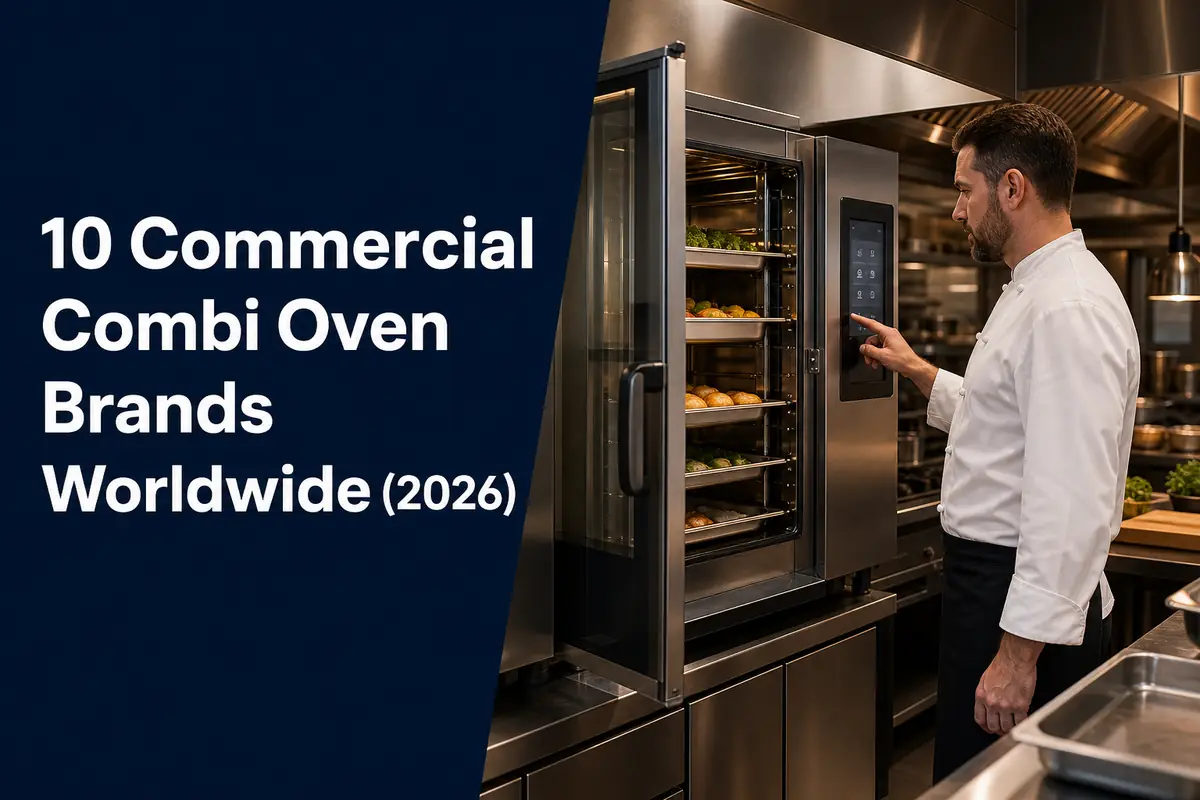
# 10 Commercial Combi Oven Brands Worldwide (2026): Global Buyer Guide
A commercial combi oven can steam, roast, bake, regenerate and cook with controlled combinations of heat and moisture. That versatility can replace several single-purpose appliances—but only when the oven matches the menu, production volume, utilities, ventilation, cleaning process and local service network.
This guide compares 10 established manufacturers with current professional combi-oven ranges. Brands are listed alphabetically, not ranked. ChefPin accepted no payment for inclusion or position. Model ranges, certifications, prices and support differ by country, so use this as a shortlist rather than a substitute for a kitchen consultant, site survey or live cooking trial.
For a broader equipment plan, see ChefPin's guide to commercial kitchen equipment brands worldwide.
Quick comparison of 10 commercial combi oven brands
| Brand | Current combi family or focus | Useful starting point for | Verify locally |
|---|---|---|---|
| Alto-Shaam | Prodigi and Converge | Restaurants, catering and multi-cook production | Model availability, hood requirement and service coverage |
| Convotherm | maxx, maxx pro and mini | Hotels, production kitchens, baking and chains | Boiler versus injection, door format and local parts |
| Electrolux Professional | SkyLine Combi | Hotels, institutions and coordinated equipment projects | Utility package, software tier and authorized service |
| Eloma | GENIUS MT, MULTIMAX and JOKER | Restaurants, retail, catering and compact kitchens | Control level, cleaning system and distributor stock |
| HOUNÖ | Invoq Combi, Hybrid and miniCombi | Restaurants, retail, catering and bakeries | Hybrid options, water treatment and regional support |
| Lainox | Naboo 5.0 and Compact Naboo | Restaurants, hotels and space-conscious sites | Model generation, cloud functions and chemical supply |
| MKN | FlexiCombi and SpaceCombi | Hotels, institutions and high-capacity kitchens | Rack format, cleaning cartridges and service response |
| RATIONAL | iCombi Pro and iCombi Classic | Broad multi-site and independent foodservice | Configuration, accessories, water and service contract |
| Retigo | Blue Vision and Orange Vision | Restaurants, institutions and production kitchens | Injection versus boiler, local importer and parts stock |
| UNOX | CHEFTOP-X and CHEFTOP MIND.Maps | Restaurants, bakery crossover and connected operations | Control package, washing consumables and service network |
The most expensive oven is not automatically the best, and the lowest quote may omit essential items. Compare complete installed and supported systems using the same menu test and tender schedule.
1. Alto-Shaam
Alto-Shaam offers commercial combi ovens including the Prodigi range and multi-chamber Converge systems. Its portfolio covers countertop and larger-capacity production configurations, with selected models supporting connected management, automated recipes and optional features such as smoking or grease handling.
Why shortlist it: Operators that want conventional combi production or independently controlled cooking chambers can evaluate different approaches within one manufacturer.
What to verify: Confirm which features are standard on the quoted model and which are chargeable options. Obtain written requirements for ventilation, drainage, water quality, clearances and cleaning chemicals. Ask who performs commissioning and warranty service in the installation city.
2. Convotherm
Convotherm supplies maxx pro, maxx and compact mini combi-oven families in countertop and floor-standing formats. Depending on configuration, features may include automatic cooking, climate management, cleaning programs, connectivity and boiler or injection steam.
Why shortlist it: The range serves compact restaurants through higher-volume hotels, institutional kitchens and baking-focused operations, with different control and capacity levels.
What to verify: Compare the exact steam-generation method, electrical or gas load, tray standard and door configuration. A disappearing door can materially affect aisle planning, but only if it is available and serviceable in your chosen configuration.
3. Electrolux Professional
Electrolux Professional SkyLine combi ovens combine steam and convection cooking with automated programs, cleaning and workflow-oriented controls. The wider Electrolux Professional portfolio can also matter when a project is specifying coordinated cooking, refrigeration and warewashing equipment.
Why shortlist it: Hotels, hospitals, education kitchens and multi-equipment tenders may value a broad commercial platform and the ability to coordinate service across several equipment categories.
What to verify: Ask the dealer to identify the precise SkyLine tier, size, steam system and software features in the quotation. Confirm whether remote monitoring requires accounts, subscriptions or network configuration, and establish who retains access to operating data.
4. Eloma
Eloma manufactures professional combi steamers including GENIUS MT, MULTIMAX and compact JOKER formats. Current ranges span countertop, compact and floor-standing production needs, with multiple operating modes and automated-cleaning options depending on model.
Why shortlist it: Buyers seeking German-built combi steamers with compact, standard and high-capacity options can compare several interface and automation levels.
What to verify: Confirm the current model generation and whether accessories from an existing installation remain compatible. Obtain the local cleaning-chemical specification, parts availability and technician coverage rather than relying only on the factory's global presence.
5. HOUNÖ
Danish manufacturer HOUNÖ offers Invoq Combi, Hybrid, Essence, miniCombi and baking-oriented ovens. The range includes gas and electric configurations, multiple GN sizes, pass-through variants and connected tools, depending on market and model.
Why shortlist it: Restaurants, caterers, retail kitchens and bakeries can evaluate conventional combi and hybrid concepts within one product family.
What to verify: Have the dealer explain what “Hybrid” means in the exact quoted unit and demonstrate it with your menu. Confirm water-treatment requirements, hood solution, cleaning consumables, training and the location of stocked critical parts.
6. Lainox
Lainox Naboo 5.0 is a connected professional combi-oven platform for grilling, roasting, steaming, baking and other applications. Lainox also offers compact configurations for kitchens with constrained space and related cooking platforms for different service styles.
Why shortlist it: Operators prioritizing recipe management, touchscreen workflows and compact choices may find a configuration suited to restaurant, hotel or retail production.
What to verify: Make sure every quoted cloud, diagnostic or cooking feature is licensed and available in your country. Check the screen workflow with the employees who will actually use it, including temporary or less experienced staff, and confirm ongoing detergent and descaler supply.
7. MKN
MKN FlexiCombi combi steamers focus on professional production, guided cooking, capacity and connected kitchen management. MKN also offers the narrower SpaceCombi platform for locations where depth and floor space are limited.
Why shortlist it: Hotels, institutions and production kitchens may value rack-capacity options, automated workflows and documented consumption monitoring.
What to verify: Standard GN capacity and MKN's alternative rack arrangement should be compared using your real pans and batch sizes. Price the approved cleaning cartridges, water treatment and accessories for the contract period, not just the first delivery.
8. RATIONAL
RATIONAL iCombi Pro and iCombi Classic cover intelligent and more conventionally controlled professional combi cooking. The platform spans compact through roll-in production sizes, with connected kitchen management, automatic cooking and cleaning features varying by line and configuration.
Why shortlist it: RATIONAL has broad international distribution and a large installed base, making it a common benchmark for independent restaurants, hotels, contract caterers and multi-site groups.
What to verify: Do not accept a brand-only quotation. Specify line, size, energy source, voltage, door hinge, rack system, cleaning package, accessories and commissioning. Compare the local service partner's response and parts commitment with the strength of the product demonstration.
9. Retigo
Retigo Vision combi ovens include Blue Vision and Orange Vision ranges across countertop and floor-standing capacities. Depending on series and size, configurations can include injection or boiler steam, gas or electric heat, automatic cleaning and guided cooking.
Why shortlist it: The range gives restaurants and institutional kitchens several control and capacity levels, which can make Retigo a useful alternative quote in a competitive tender.
What to verify: The quality of the regional importer is critical. Ask for installed references near your site, named technicians, spare-parts inventory and escalation procedures. Compare the exact Blue or Orange specification rather than treating the families as equivalent.
10. UNOX
UNOX CHEFTOP-X is a gas or electric professional combi range with connected controls, automated cooking and washing features. UNOX also maintains CHEFTOP MIND.Maps variants and a broad commercial oven portfolio serving gastronomy and bakery applications.
Why shortlist it: Restaurants and bakery-crossover operations may value the range of GN sizes, digital workflows and the option to conduct a cooking trial with their own food.
What to verify: Confirm which intelligent functions, sensors and connectivity services come with the quoted control package. Model-specific consumption figures require consistent assumptions, so compare them only against equivalent test conditions and your expected production.
What a combi oven actually combines
A conventional convection oven circulates dry hot air. A steamer cooks with moist heat. A combi oven can use either mode or manage heat and humidity together, allowing one cabinet to roast, steam, bake, regenerate, proof, hold or cook at low temperature when properly configured.
That does not mean every combi replaces every appliance. A high-volume fryer, charbroiler, deck oven or pressure steamer may still outperform it for a specialized task. Build the equipment schedule from menu volumes and service deadlines, not from a list of possible cooking modes.
Nine checks before requesting quotations
1. Convert the menu into production loads
List every item the oven will cook, its raw weight, pan type, portions per batch, loading frequency and service deadline. Separate peak demand from average demand. The number of advertised trays means little if your deepest roasting pan blocks the rack above it.
2. Choose GN or bakery format deliberately
Confirm whether the operation uses GN 1/1, GN 2/1, hotel pans, sheet pans, bakery trays or a mixture. Adapters can reduce usable capacity and airflow. Bring your real pans to the live test.
3. Survey electrical or gas capacity
Large combi ovens can require substantial power, gas, water, drainage and ventilation. Ask a qualified local professional to confirm capacity before purchase. A cheaper oven becomes expensive when the building needs an unplanned electrical-service upgrade.
4. Test the water
Water chemistry affects steam generation, scale, corrosion, food quality and warranty compliance. Send a current water sample for analysis and obtain the manufacturer's written treatment specification. Include filters, cartridges, bypass settings, monitoring and replacements in the quote.
5. Resolve ventilation and heat rejection
“Ventless” is a configuration claim, not blanket permission to ignore local mechanical and fire rules. Confirm hood type, condensate management, grease-producing applications and approval with the relevant authority and kitchen designer.
6. Plan drainage and cleaning chemicals
Verify drain material, temperature rating, air gap, fall and nearby service access. Automated washing usually depends on approved detergent and descaler. Compare chemical cost per actual cycle and safe storage requirements.
7. Check physical access
Measure the delivery route, doorways, lifts, corners, ceiling, plinth and final service clearances. Record the oven with door open and with racks or trolleys moving. A floor-standing unit that fits the kitchen plan may not fit through the building.
8. Audit local service
Ask for the name and location of authorized technicians, normal response time, after-hours policy and locally stocked parts. Contact two nearby users whose units are past the first year of warranty.
9. Define training and recipes
Commissioning is not the same as culinary implementation. Include administrator setup, chef training, cleaning instruction, recipe conversion and follow-up after several weeks of operation.
Capacity: do not size from meal counts alone
Manufacturers sometimes describe models using approximate meals per day. Actual output depends on menu, tray spacing, food density, preheating, recovery, desired browning and how many products can share a load.
Use this calculation for each critical menu item:
Required batches per service = peak portions ÷ proven portions per tested load
Then determine whether those batches fit between preparation and service. If the oven is also regenerating banquets at the same time, that capacity is not available for roasting. A second smaller oven or stacked pair can offer redundancy and simultaneous climates that one larger cabinet cannot.
Boiler steam or injection steam?
Both systems can produce professional results. A boiler generates steam in a separate system, while injection designs introduce water into the hot cooking chamber or onto a steam-generating surface. The practical comparison includes:
- Speed and consistency at the required steam load
- Water chemistry and scale management
- Maintenance access and component cost
- Energy and water consumption in your production pattern
- Recovery between loads
- Local technician familiarity
Do not select from a generic claim that one technology is always superior. Cook the most steam-sensitive and high-volume products in the exact models under consideration.
A fair live cooking trial
Bring the same ingredients, pans, load weights and target results to every supplier. Test at least:
- A full load of a high-moisture product such as vegetables
- A browning-sensitive roast or protein
- A bakery item that reveals airflow uniformity
- A mixed or timed load if that reflects normal service
- Regeneration of the actual plated or bulk product
- The shortest cleaning cycle appropriate after the test
Record preheat time, cooking time, yield, weight loss, color variation by rack, recovery, noise, door heat, water use where measurable and staff observations. Photograph every rack under the same lighting.
Total cost of ownership
Compare at least five to ten years if the organization has reliable assumptions:
Lifecycle cost = purchase + freight + installation + building works + accessories + energy + water + chemicals + filters + planned service + repairs + software + downtime − residual value
Request separate line items for stands, stacking kits, hoods, hand showers, probes, trolleys, tray racks, water treatment, commissioning and training. Require suppliers to state what is excluded.
Energy calculators can help, but only when the duty cycle, tariff and comparison baseline are disclosed. Use your local utility rates and test a realistic menu instead of copying a percentage saving from marketing material.
Questions to send every supplier
- What is the complete model and factory option code?
- Which trays and usable rack spacing apply to our menu?
- What are the connected electrical, gas, water and drain loads?
- What water-quality limits and treatment system are required?
- Which hood or ventilation approvals apply to our cooking processes?
- What is included in automatic cleaning, and what does each cycle consume?
- Which connectivity functions require a subscription or account?
- Who owns and can export our recipes, HACCP records and equipment data?
- Who installs, commissions, trains and signs off the warranty?
- Where are the nearest authorized technician and critical spare parts?
- What response time and labor rates apply after warranty?
- How long are parts and software updates expected to remain available?
- Can we trial the exact model with our menu and pans?
- Can you provide three comparable local reference sites?
- What items and works are excluded from the quotation?
Common purchasing mistakes
- Choosing touchscreen appearance before testing food quality and workflow
- Comparing one supplier's base oven with another's fully installed package
- Ignoring water analysis until scale causes faults
- Assuming an existing hood, drain or electrical circuit is adequate
- Buying maximum capacity without checking low-volume efficiency
- Forgetting trolley, pan and blast-chiller compatibility
- Accepting generic “24/7 service” without a local response commitment
- Underbudgeting cleaning chemicals, filters and preventive maintenance
- Allowing recipes to live only in one employee's personal account
- Training managers but not the night, weekend and cleaning teams
Installation and acceptance checklist
Before final payment, verify:
- Model, serial number, options and accessories match the purchase order
- Utilities and isolation points match approved drawings
- Water treatment is installed, flushed and set correctly
- Oven is level, restrained where required and has service clearances
- Drainage and condensation operate under a full steam test
- Hood or listed ventless system has required local approval
- Door, probe, racks, trolley and hand shower operate safely
- Cooking temperature and core probe are checked as required
- Automatic cleaning completes without leaks or errors
- Administrator accounts and data ownership are documented
- Chefs and cleaners receive signed training
- Manuals, warranty, service contacts and preventive plan are handed over
Final recommendation
Shortlist three brands with competent local service, issue the same technical schedule and run the same menu test. Score cooking results, workflow, installed cost, utilities, cleaning, staff usability, service and lifecycle risk separately. Keep brand reputation as one input—not the decision itself.
A combi oven works best as part of a system. Coordinate it with cold storage, blast chilling, extraction, warewashing and the rest of the line using the global commercial kitchen equipment guide. Equip the team with suitable chef uniforms and aprons, professional kitchen footwear and documented role expectations from ChefPin's chef job description template.
ChefPin connects hospitality employers and culinary professionals. Create your ChefPin account to develop your profile, find opportunities or plan your next kitchen hire.
---
Editorial note: Brands are included alphabetically without payment. Product information was checked against official manufacturer materials in August 2026 and may change. This guide provides general purchasing information, not engineering, fire-safety, food-safety or legal advice. Use qualified local professionals and current manufacturer documentation. Any future sponsored link will be clearly disclosed and will not silently control editorial position.