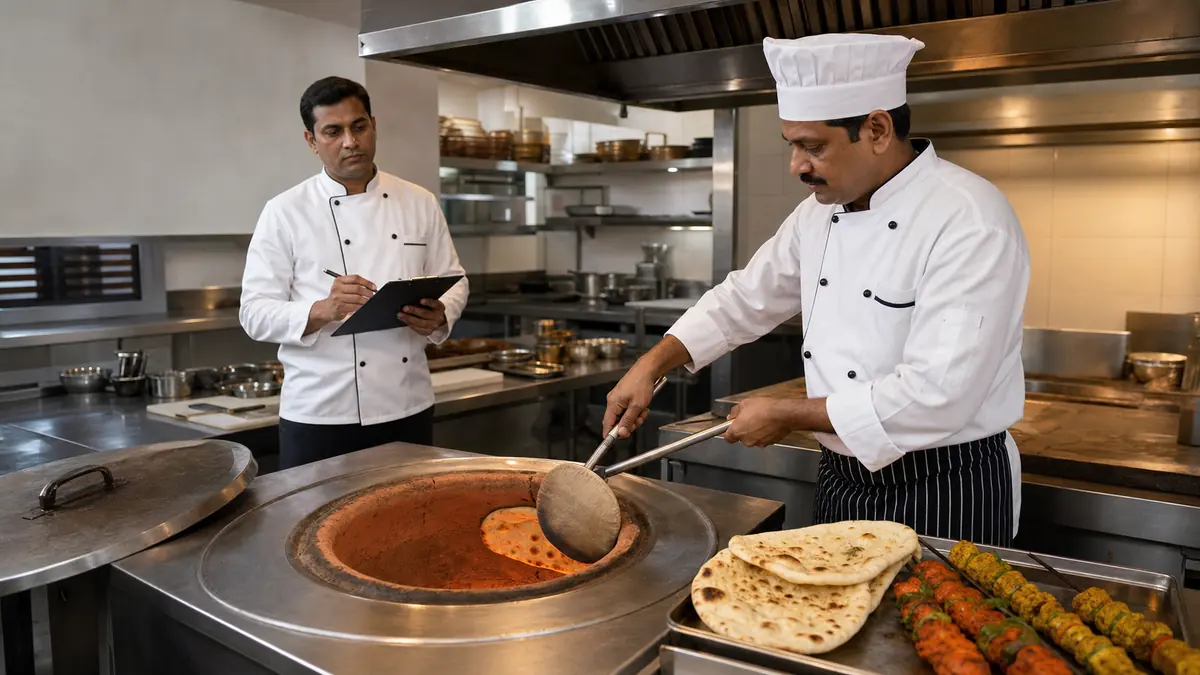
Hiring a tandoor chef requires more than tasting one good kebab or naan. Employers need to assess heat control, dough and marinade consistency, mise en place, speed, hygiene, yield, and the ability to repeat the same result throughout service.
This guide gives restaurants, hotels, caterers, and cloud kitchens a structured interview, practical trial, and 100-point scorecard for evaluating Tandoor Chef candidates.
Quick answer: Define the exact products and service volume first. Ask every candidate the same core questions, test a small selection from your real menu, score observable performance, and verify experience before making an offer.
Define the Tandoor Chef role first
“Tandoor Chef” can describe very different jobs. One outlet may need high-volume naan and roti production. Another may depend on kebabs, tikka, whole fish, vegetables, and plated starters. A hotel may also expect banquet production, buffet holding, live counters, requisitions, and team supervision.
Before interviewing, clarify:
- Which breads the station produces
- Which vegetarian and non-vegetarian items belong to the station
- Whether the chef prepares doughs and marinades or receives them from a central section
- Average covers, orders, or banquet volume
- À la carte, buffet, banquet, delivery, or live-counter service
- Type and number of tandoors
- Fuel and operating procedures used by the kitchen
- Team size and reporting line
- Responsibility for ordering, yield, wastage, and stock
- Whether the role includes Indian curry, grill, or other kitchen duties
If the requirement is primarily tandoor production, start with ChefPin’s Tandoor Chef talent pool. If the role includes wider North Indian menu ownership, also compare candidates with relevant cuisine and leadership experience instead of relying on title alone.
Skills to verify
Use the job description, interview, and trial to examine the same core capabilities.
Tandoor operation
The candidate should explain how they prepare the station, bring the tandoor to working condition, judge and adjust heat, organize tools, and maintain output during changing service demand.
Do not accept unsafe demonstrations. Evaluate only within your equipment manufacturer’s instructions and the restaurant’s approved operating procedures.
Bread production
Check dough understanding, portioning, shaping, thickness, adhesion, puffing, cooking, removal, finishing, and consistency. The exact test should match your menu: naan, roti, kulcha, laccha-style bread, or another house product.
Kebabs and tandoor items
Look for correct preparation, skewer loading, spacing, cooking control, finishing, moisture, texture, and repeatability. Judge vegetarian and non-vegetarian products separately where both are served.
Mise en place and service flow
A capable chef should plan batches, protect quality during rush periods, communicate shortages early, and coordinate with curry, grill, service, and pass teams.
Hygiene and separation
Observe hand hygiene, clean tools, safe storage, and separation of raw and cooked food. Where applicable, check the separation of vegetarian and non-vegetarian ingredients, equipment, containers, and work areas.
FSSAI’s restaurant food-safety guidance emphasizes clean premises and uniforms, handwashing, thorough cooking, correct hot and cold holding, and separation of raw from cooked and vegetarian from non-vegetarian food. Review the current FSSAI food-handler guidance when designing your kitchen procedures.
Cost and yield awareness
The chef should understand portions, skewer yield, trimming, dough loss, marinade usage, breakage, overproduction, and avoidable wastage. Senior candidates should be able to explain how they investigate and correct a rising food-cost or waste problem.
Tandoor Chef interview questions
Use the same core questions for every shortlisted candidate. Ask follow-ups when an answer needs evidence.
Experience and role-fit questions
- Describe the most comparable tandoor station you have worked on.
- Which breads and tandoor items did you personally prepare every day?
- What was the approximate service or banquet volume?
- How many tandoors and team members were involved?
- Which preparation, ordering, or supervisory duties did you own?
- Which items from our menu would be immediately familiar, and which would require training?
Strong answers include specific products, responsibilities, volumes, equipment, and service formats.
Heat and equipment questions
- How do you prepare your station before lighting or starting the tandoor?
- How do you judge whether the heat is right for breads versus skewered items?
- What do you do when heat falls during a busy service?
- How do you prevent uneven cooking when several orders arrive together?
- What warning signs tell you to stop and report an equipment or ventilation problem?
Look for a controlled process that follows site procedures. Reject answers that treat unsafe improvisation as skill.
Bread questions
- How do you keep bread size and thickness consistent across a shift?
- What causes bread to fall, tear, dry out, or cook unevenly?
- How do you organize dough portions for expected service without overproducing?
- How would you troubleshoot repeated quality complaints about naan?
The candidate should connect each problem with practical causes such as dough condition, shaping, surface preparation, heat, timing, or handling.
Kebab and marinade questions
- How do you keep marination consistent from one batch to the next?
- How do you control portion size and skewer yield?
- How do you prevent a product from drying while ensuring it is properly cooked?
- How do you handle a last-minute increase in orders without serving an underprepared batch?
- How do you separate allergen-sensitive, vegetarian, and non-vegetarian preparation according to the kitchen’s procedures?
Do not judge candidates only on secret recipes. Systems, consistency, safe handling, and the ability to execute your approved recipe are more valuable than vague claims.
Service and teamwork questions
- How do you plan mise en place for a normal day and for a banquet?
- What information do you need from service or the pass during a rush?
- How do you communicate an item shortage or delay?
- How would you train a new Commis Chef on the station?
- Tell us about a service problem you caused or inherited and how you corrected it.
What good answers sound like
There is rarely one perfect sentence. Look for candidates who:
- Explain a sequence rather than saying “I know everything”
- Distinguish preparation, cooking, holding, and service
- Give examples from comparable kitchens
- Discuss both quality and speed
- Recognize hygiene and safety limits
- Understand portions, yield, and waste
- Ask sensible questions about your menu and equipment
- Accept standard recipes and feedback
- Communicate without blaming other departments
Be cautious when someone cannot describe their own daily responsibilities or gives the same answer for every product and service format.
Design a fair practical trial
The trial should represent the actual role. Do not ask candidates to prepare an unrelated showpiece simply because it is impressive.
Choose three to five items from your menu that reveal different skills. A useful trial might include:
- One core bread
- One more demanding or high-volume bread
- One vegetarian tandoor item
- One non-vegetarian item, if relevant to the outlet
- One item that tests portioning, timing, or finishing under service conditions
For a senior role, add a short planning task: calculate mise en place for a stated number of covers, identify likely wastage points, or explain how the candidate would organize two cooks during a rush.
Tell the candidate in advance:
- Trial location and reporting person
- Start time and expected duration
- Products and facilities available
- Whether a uniform, shoes, knives, or documents are required
- What will be assessed
- Compensation or travel reimbursement, where provided
- Any site safety and hygiene requirements
Use the same brief and ingredients for candidates being compared.
Copyable trial brief
Objective: Prepare the selected tandoor items to the restaurant’s portion, taste, texture, presentation, hygiene, and timing standards.
Candidate receives:
- Written recipe or required output
- Portion sizes
- Available ingredients and equipment
- Service order or production quantity
- Time limit
- Kitchen safety and hygiene briefing
Candidate must demonstrate:
- Station setup and mise en place
- Safe, organized work
- Heat and timing control
- Consistent shaping, skewering, and portions
- Correct cooking and finishing
- Communication during the task
- Cleaning and handover
Do not use a trial as an unstructured unpaid shift. Keep it limited to assessment, explain the terms beforehand, and obtain local HR or legal guidance where the candidate produces usable commercial work.
100-point Tandoor Chef trial scorecard
| Assessment area | Weight | What to observe |
|---|---|---|
| Planning and mise en place | 10 | Reads the brief, sequences work, and prepares sensible quantities |
| Tandoor and heat control | 15 | Works within procedures and maintains appropriate, stable heat |
| Bread technique | 15 | Shape, thickness, adhesion, cooking, removal, texture, and consistency |
| Tandoor item technique | 15 | Preparation, loading, cooking, moisture, texture, and repeatability |
| Taste and seasoning | 10 | Balance and match with the restaurant’s approved profile |
| Hygiene and separation | 15 | Clean hands and tools, safe storage, and correct raw/cooked and veg/non-veg separation |
| Speed and service flow | 10 | Meets the brief without losing control or quality |
| Portion and waste control | 5 | Consistent yield and minimal avoidable waste |
| Communication and teamwork | 5 | Clear questions, updates, listening, and respectful conduct |
| Total | 100 | Record evidence beside every score |
Set the acceptable score before the trial. Also define any non-negotiable failure—for example, a serious safety or hygiene breach—so a high taste score cannot hide unacceptable risk.
Questions to ask after the trial
- Which part of the trial best represented your normal work?
- What would you change if you repeated it?
- Which product or process would need orientation in our kitchen?
- Where did you see possible waste or delay?
- What support would you need during your first week?
- How would you organize this station at our expected volume?
Self-awareness is valuable. A candidate who identifies a real mistake and explains the correction may be stronger than someone who claims the trial was perfect.
Verify references and practical fit
With the candidate’s permission, ask a former chef, kitchen leader, restaurant manager, or HR representative to confirm:
- Job title and employment period
- Actual tandoor and menu responsibilities
- Typical volume and service format
- Reliability and attendance
- Hygiene and teamwork
- Supervisory responsibility
- Eligibility for rehire, where the referee can share it
Before making an offer, confirm compensation expectations, joining date, location, shifts, weekly-off arrangements, meals, accommodation or transport, and any uniform or tool requirements.
Employers searching locally can review ChefPin talent pages such as Tandoor Chefs in Bengaluru, Tandoor Chefs in Delhi, and Tandoor Chefs in Mumbai.
Common hiring mistakes
- Treating all tandoor roles as identical
- Testing only taste and ignoring consistency
- Using different briefs for each candidate
- Judging recipes without explaining the restaurant’s required profile
- Ignoring volume, banquet, or delivery experience
- Failing to assess breads and kebabs separately
- Overlooking hygiene, separation, and safe equipment use
- Hiding shifts, benefits, or compensation until late
- Skipping references because the trial went well
- Delaying the offer until a strong candidate accepts another role
Frequently asked questions
What should a Tandoor Chef trial include?
Use three to five items from the real menu that test bread, tandoor cooking, portions, timing, hygiene, and consistency. Senior candidates should also complete a short planning or yield task.
How long should a practical trial take?
The duration depends on the products, preparation supplied, and seniority. Set a realistic limit in advance and keep the exercise focused on assessment rather than normal production work.
Should employers give candidates their recipes?
Provide enough information to assess whether the candidate can follow the restaurant’s required portion and flavour profile. A trial should test professional execution, not the ability to guess an undisclosed house recipe.
Is the best-tasting candidate always the best hire?
No. Taste matters, but restaurants also need safe handling, repeatability, speed, yield control, teamwork, and reliable service performance.
Where can employers find Tandoor Chefs?
ChefPin allows hospitality employers to browse candidates by role, cuisine, and location. Start with the Tandoor Chef hiring page, then narrow the shortlist according to menu, volume, city, and joining requirements.
Start hiring
Create a ChefPin employer account to find Tandoor Chefs and other hospitality professionals for your restaurant, hotel, catering operation, or cloud kitchen.